


Blind Spot: Hitler's Secretary
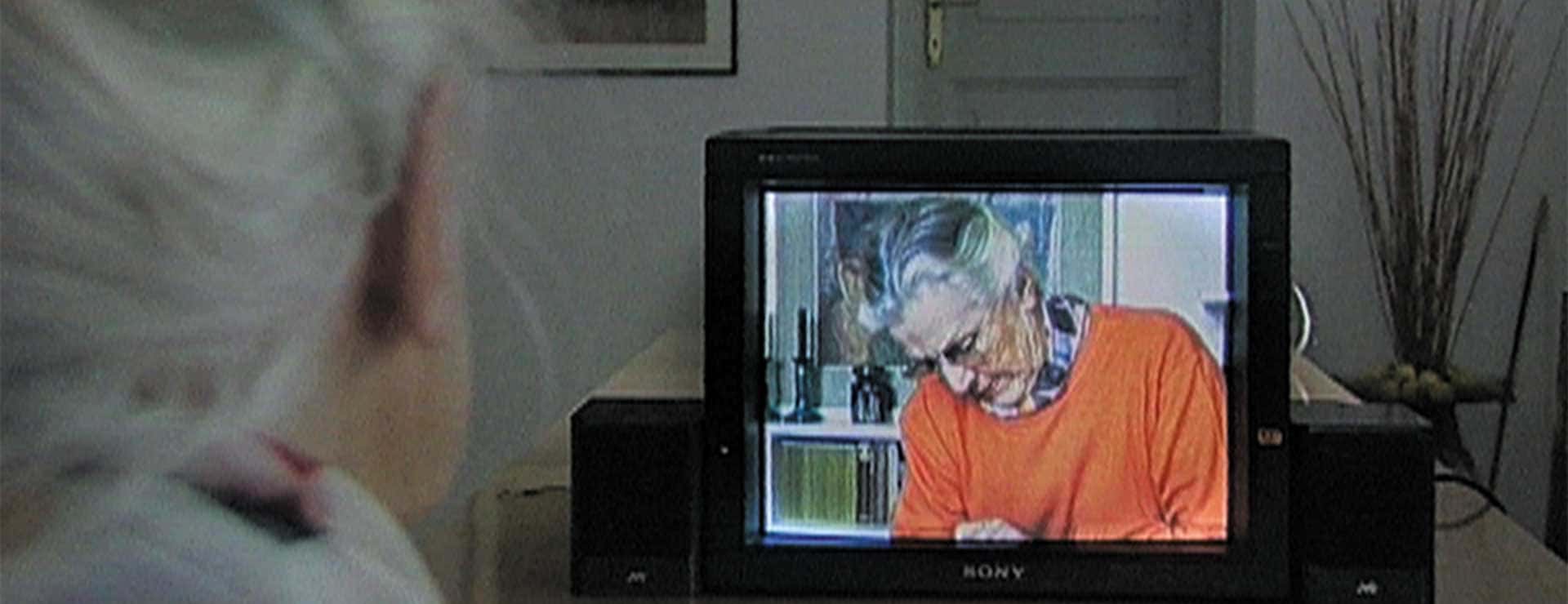
Traudl Junge was one of Adolf Hitler's private secretaries from 1942 until the collapse of Nazi rule. She worked for him at the Führer's headquarters in the Wolfsschanze, in the Berghof at Obersalzberg, on the special train and in Berlin. In 1944, she witnessed the failed Stauffenberg assassination attempt; she experienced the last days of the war and Hitler's suicide in the Führer's bunker in the encircled capital. Traudl Junge was also the one who dictated Hitler's "will." In BLIND SPOT: HITLER'S SECRETARY she spoke publicly about her life, her memories, disturbances and self-reflections. When Traudl Junge tells of the last days before Hitler's suicide in the Führerbunker - a 25-minute monologue without any film editing - the image of emptiness at the center of an inhuman power emerges, almost frightening in its impressiveness and presence.
"I come from the tradition of storytelling, of listening. An exciting character telling something exciting doesn't need an accessory." ANDRÉ HELLER
Traudl Junge
DVD Edition # 22

ABOUT THE FILM


After the Downfall
The Memories of an Eyewitness: Im toten Winkel
Bert Rebhandl*
Traudl Junge was the secretary who wrote down Adolf Hitler’s “Political Testament.” She was among the last people in the Berlin bunker to see the “Führer” alive. She witnessed the collapse of Nazi Germany from the immediate distance of an uninvolved eyewitness.
After the war, Junge—who was easily denazified as a “young follower”—lived in Munich. She remained alone with her story. Only the author Melissa Müller took an interest in her and published her recollections from the Führerbunker’s “blind spot” under the title Bis zur letzten Stunde.
Through Melissa Müller, André Heller and Othmar Schmiderer came into contact with Junge. In the spring of 2001, they conducted several long interviews with her while a camera recorded the conversations. The resulting ten hours of footage were assembled into a three-and-a-half-hour working version, which Traudl Junge was shown once more. She was given the opportunity to review her account and clarify certain points—this process, too, was filmed.
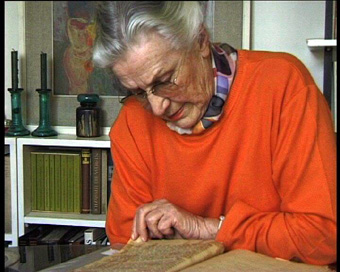
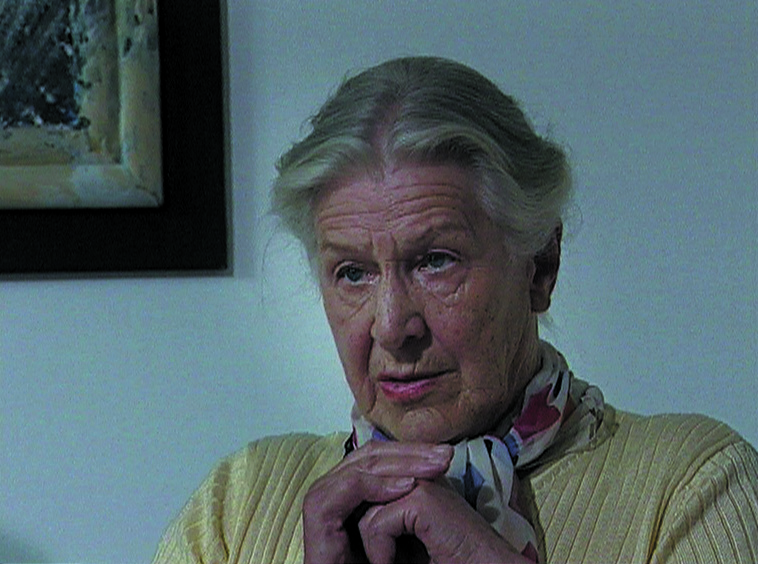
The final version is a documentary that concentrates entirely on its protagonist. Im toten Winkel consists almost exclusively of medium close-ups of Traudl Junge speaking directly into the camera. There are no intercut commentaries, no verification of her statements through other sources, no corrections of factual inaccuracies.
“Im toten Winkel presents the extended monologue of a woman who had many years to gather herself for this account.”
There are no questions either—with one characteristic exception, they have all been omitted in the editing.
Im toten Winkel presents the extended monologue of a woman who had many years to gather herself for this account. Even in her direct speech, one senses that she had rehearsed these sentences countless times in her mind. Looking back, she is somewhat bewildered that she had “lived so carefree” in her youth, yet she cannot “be angry” with “that childish young girl” she had been in 1942.
She worked for Hitler for three years and remained close to him throughout that time: at the Wolfsschanze in East Prussia, at the Berghof in southern Germany, and finally in besieged Berlin. She experienced Hitler’s private side, although in retrospect she hesitates to portray “his human qualities so clearly.” She witnessed how Hitler emerged strengthened by the assassination attempt of 20 July 1944—more convinced than ever that he was guided by destiny. Several times, Junge returns to the metaphor of “dancing on a volcano” to describe the surreal nature of life inside the bunker.
She never took the cyanide capsules she always carried with her. She survived the downfall. Traudl Junge died one day after the film’s premiere. Shortly before her death, she is said to have remarked: “I think I’m beginning to forgive myself.”
*Regular contributor to Der Standard, lives as a freelance journalist in Berlin.
I come from the tradition of storytelling, of listening. A compelling person telling a compelling story needs no embellishment.
ANDRÉ HELLER
Quiet Horror
The Austrian writer Ilse Aichinger on Im toten Winkel*
Hopelessly united are the actors in a murderous and amateurish farce. The “blind spot” in Heller and Schmiderer’s film is not only the Wolfsschanze in East Prussia but also the Führer Headquarters in Berlin, where whatever remains to be celebrated is celebrated: not Four Weddings and a Funeral, but only two weddings (among them Hitler’s to Eva Braun) and the deaths for which they are tailored. The costume party is coming to an end. So are its colours: field grey, cornflower blue, the failed light brown of the uniforms. The sky was neither above nor below; once again, it was playful. At least there was still champagne, red roses and gunshots to the head: the attributes of an endgame in a petit-bourgeois world that could no longer be disguised by a mountain backdrop.
Only one person in this scene remains credible: Hitler’s secretary, Traudl Junge, calm and horrified. Her bearing, her clothes and her hairstyle create a distance that does not attempt to overlook the abyss. That is what distinguishes her from the “old Nazis.” She has no pathos, not even the pathos of acknowledged guilt. The way she pronounces the names of this final retinue—Gretl Fegelein, Eva Braun, Mrs Goebbels—lends them gravity. Any irony would be wasted on them. And when she speaks of the Silentia typewriters used for the final letters and decrees—they had to be almost silent because Hitler had a panicked fear of noise—it offers a vivid picture of his mindless egocentrism and its details.
“So now we are rolling through the night,” Traudl Junge says of the year 1942, “right across Germany, in complete comfort.” They travel, protected and shielded, from East Prussia to Upper Bavaria, from the Wolfsschanze to the Berghof, from one absurd cliché to the next. “The floors of all the railway carriages were covered with velour. Hitler had his own bathroom, although the train included a bath carriage with shower rooms.” Everything was “informal and simple.” The “solemn snow-covered forest” of East Prussia lay behind them, along with “that little sadness of leaving the North,” as she calls it.
At the Berghof: “Much of it I already knew from postcards. Wooden chandeliers, floor-to-ceiling windows opening onto a view of the Salzburg region.” Nothing distinguished it from the parlour of a prosperous bourgeois household. There was often complete silence; Hitler slept late. In the bookcase: many volumes of an encyclopaedia, the collected works of Wilhelm Busch, Mein Kampf, bound in leather. Next door, the dental surgery of Professor Blaschke from Berlin. “Beyond that stretched enchanting rolling countryside.” The view was unobstructed for the moment, though the Steinernes Meer blocked the horizon.
Everyone was drawn into Hitler’s irregular, exhausting and highly monotonous daily routine. Breakfast consisted of apple shallots and apple cake. In the cellar there was a bowling alley, where ordinary feature films were also shown. “Goebbels often wanted to drag me off to dances,” recalls Traudl Junge, who had trained as a dancer, “but I was terribly disappointed”: dances on the volcano with inexperienced dancers. In between, Hitler poisoned his favourite dog because he distrusted the cyanide prepared for him to use at the end of the war. The day ended at midnight “with a cosy chat by the fireplace. There were long conversations about art galleries and exhibitions; everyone was dreadfully bored.”
*This text first appeared on 22 March 2002 in Ilse Aichinger’s column Unglaubwürdige Reisen in Der Standard.


