



Kids movie
Childhood - that's the overriding theme in Peter Schreiner's third feature-length film. He has just found Maria, the love of his life. For the offspring of their friends, they organize children's afternoons at their home - but actually he doubts: What and how much apart from memories actually still connects him with his schoolmates and friends, who in the meantime have become parents themselves and now look at their own childhood with completely new eyes? Once again, KINDERFILM shows Peter Schreiner as a thoughtful filmmaker who, with his careful observations, searches for his place in his own world like a stranger and revolves around the question of what dreams and utopias are even possible in a bourgeois life and at what price.
"Peter Schreiner teaches you to slow down and concentrate again." FM4
Peter Schreiner, Andi Stern, Andrea Schlechta, Anna Gasser, Annemarie Zottl, Bärbel Neubauer, Bärbel Ramharter u.v.m
DVD Edition # 379

ABOUT THE FILM


“There Always Remains a Longing”
Three Motifs from Peter Schreiner’s “Kinderfilm”
Olaf Möller
The story of a young love and the questions that come with it: about the future, the joys connected to it (children), the processes involved (above all aging), and the potential constraints (earning money, compromises, possessions). Schreiner had already clarified for himself what cinema is with Grelles Licht (1982); thanks to Erste Liebe (1983), he knew what cinema can do when one entrusts oneself to it. In Kinderfilm (1985), he brings these two experiences and insights together: strictly limited to a few elements like the first film, yet free-flowing and at times associative like its successor. It is fitting that one repeatedly sees images of water flowing either over or around a stone in the same riverbed — one current, different paths.
Despite all this freedom, however, nothing remains loose: every image one sees or hears has a rhyme, and when Schreiner explains at the beginning that as a child he so badly wanted to fly because he kept falling out of bed at night, an airplane later cuts through the cloud-covered evening sky above his parents’ house.
There are three central groups of figures, or clusters, in Kinderfilm:
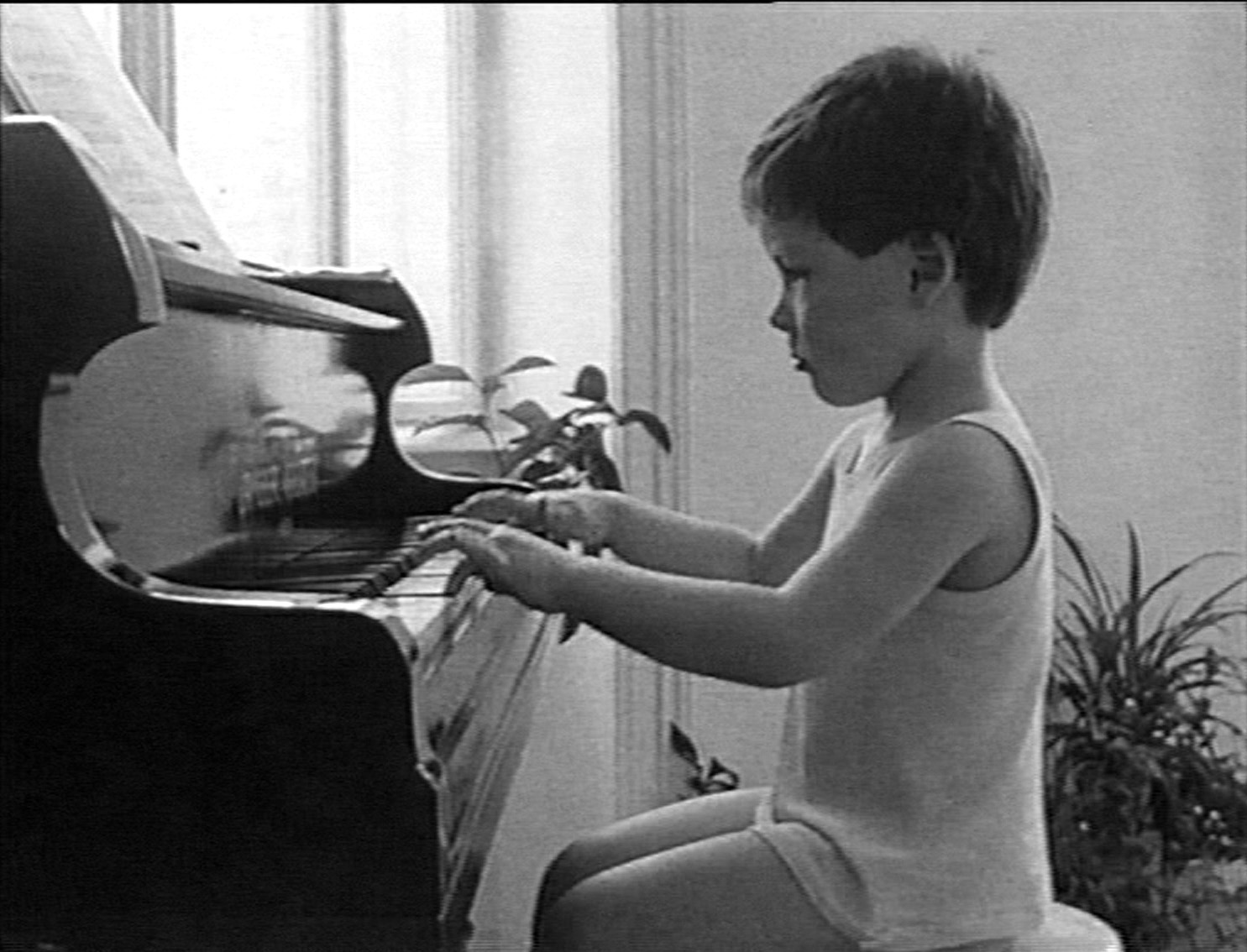
First: moments from children’s afternoons that Peter and his wife Maria organized once a week for the children of friends; the images are always constructed at the children’s eye level, meaning that they define the scale of the space and the image composition.
“Despite all this freedom, however, nothing remains loose: every image one sees or hears has a rhyme.”
Second: images of bus rides with differently disabled people of various ages; first there is one journey during which more and more people are picked up, then it expands into different rides. Despite all the laughter and constant movement, these are the quietest, calmest moments in the film; almost nothing is said, and apart from a few small gestures, nothing happens.
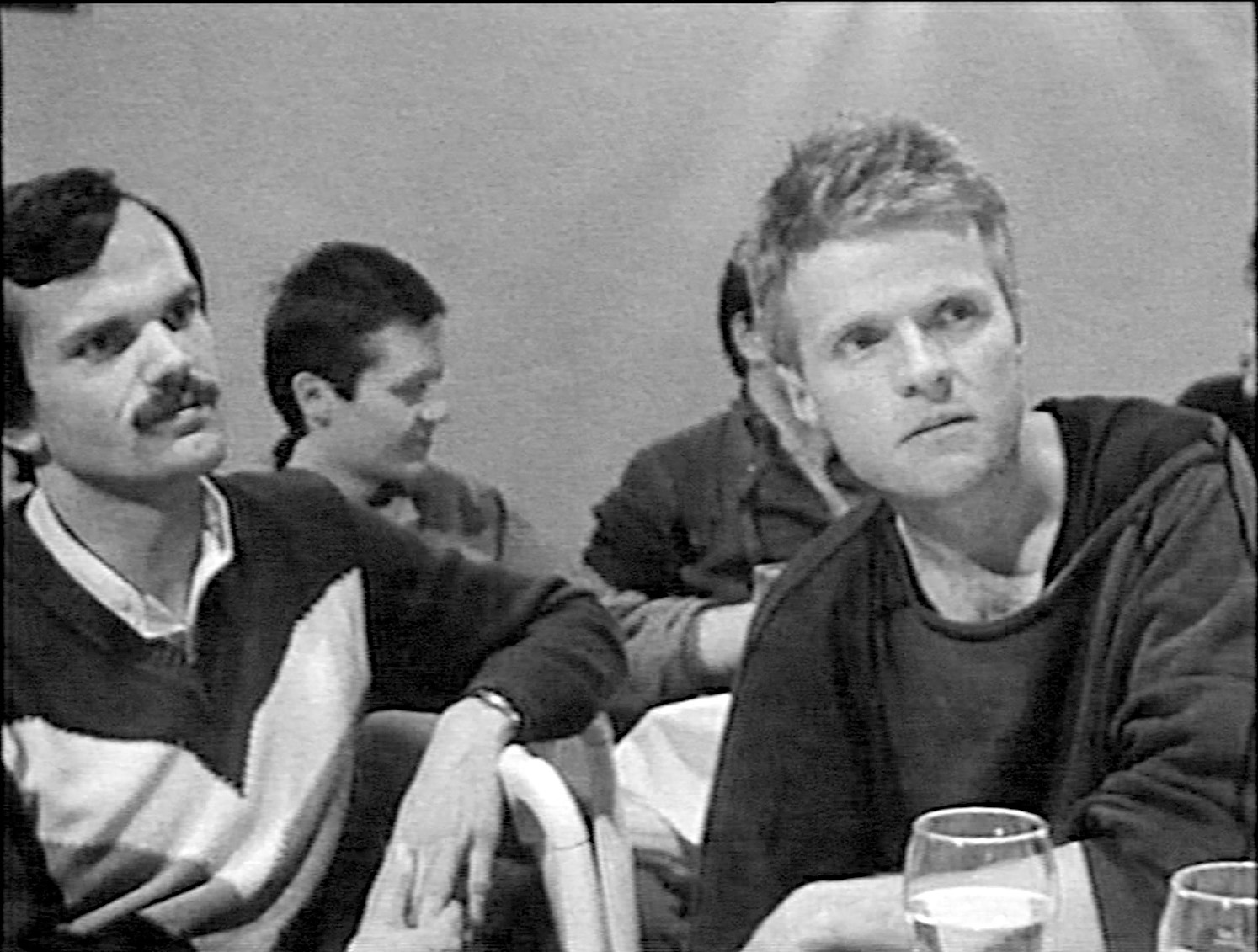
Third: scenes from Schreiner’s ten-year high school reunion. These shots were all filmed during a single evening, one is grateful will not repeat itself for at least another ten years. Schreiner appears younger than the others present because his face is more open. Everyone else seems to wear masks (which, in the case of some particularly egregious beard crimes, would probably be preferable). They carry the heavy burden of unlived futures that seem more threatening than tempting because they are associated with the loss of freedom — admittedly, some of them rationalize this away with talk of responsibility.
Schreiner, on the other hand, speaks in one scene with Maria about what it means to settle down, to build or buy a house. At one point he says: “Everything you create for yourself somehow becomes, perhaps, a burden.” Only later to formulate both the problem and the solution: “There always remains a longing.”
*Is a film author and curator. The text is an abridged version from “PETER SCHREINER. Edition Film Geschichte Österreich 9” (Filmarchiv Austria Publishing).
Peter Schreiner teaches us the value of slowness and concentration once again.
FM4
Open to the World
The Life and Work of Filmmaker Peter Schreiner
Florian Widegger
The DVD edition The Austrian Film now contains more than 350 entries — and is finally being expanded to include a work by Peter Schreiner. Schreiner may have remained unknown to a large audience, but he was one of the most extraordinary film authors in Austria: a solitary figure, a maverick, an enigma. Marked by ruptures and continuities, his body of work traverses over four decades the boundaries between documentary, fiction, and avant-garde film.
He was director, cinematographer, editor, actor, and producer all in one. In front of his camera appeared friends, family — simply kindred spirits who accompanied him along part of his journey. The starting point was always his own life, his fascination with encounters with others. His curious gaze opens up special perspectives, insights, and approaches to the world for the audience.
Already during his studies (specializing in cinematography) at the Vienna Film Academy, he was said to be unmatched in his ability to shape light. He demonstrated this in the early works of Margareta Heinrich, Bärbel Neubauer, and Niki List, with whom he was able to experiment within the collective “Rettet die Flieger.” In 1982, his first feature-length film Grelles Licht appeared — though “appeared” is meant euphemistically. For the dilemma that long haunted Schreiner’s films was that they were barely noticed. Despite this marginalization, his work continued to grow and opened itself more and more to the world with each film.
With I Cimbri, an ethnographic study about the inhabitants of a village in the Italian Alps and their dying language, he achieved a small international success in 1991, followed by a profound existential crisis with Blaue Ferne (1994). After the film encountered overwhelming indifference, Schreiner stopped making films, began theological-pastoral training, and sold or gave away all his equipment. A final break.
After almost ten years, the longing returned: once again he was drawn to a northern Italian village, to a nearly forgotten language. Once again, it was encounters — specifically his friendship with Giuliana Pachner — that created the magic of Bellavista (2006). The film received the Grand Diagonale Prize in 2007, and with Totò he was invited to the Venice Film Festival in 2009.
From then on, his international following steadily grew; the time for his ascetic yet magnificent cinema had finally arrived. In November 2022, the first monograph dedicated to his work was published by Filmarchiv Austria, accompanied by a retrospective for which Schreiner’s analog films were carefully digitally restored. One result of this work is now in your hands with this DVD, which itself becomes a piece of memory dedicated to the filmmaker: Peter Schreiner passed away on June 9, 2023, after a long and serious illness.


