


Davos
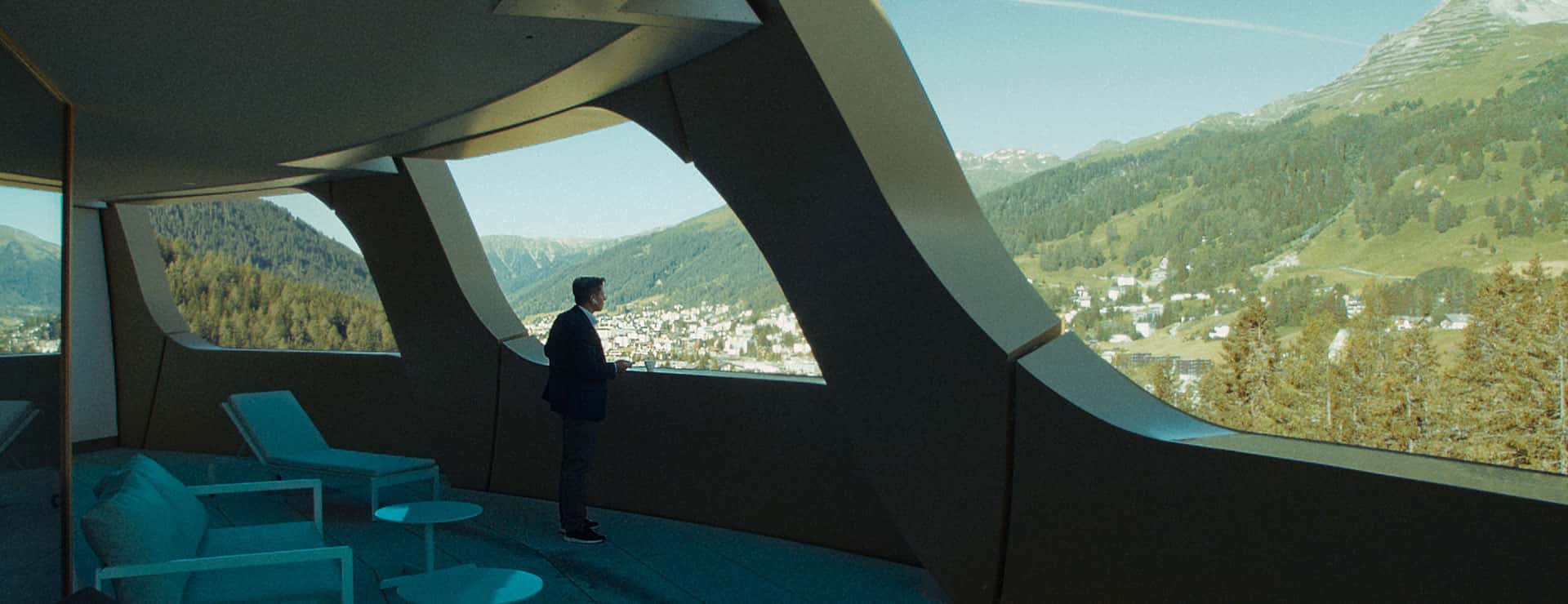
DAVOS portrays in documentary form a year in the Swiss location of the World Economic Forum. "What drives our world becomes paradigmatic in Davos: the normal and traditional life in contrast to the global elite that operates untethered from all places. DAVOS is a film about balance and contrasts, about capitalism in our fragmented world and the influence of the powerful on the many."
Andreas Ambühl, Annegret Ambühl, Arno Gehrer, Linda Herzog, Tatjana Ohm and more
Edition # 347

ABOUT THE FILM



Wealth as Bluff ...
Decision-Makers Among Themselves: „WinWin“ and „Davos“
Bert Rebhandl*
Where is the accounting?“ The police show up at the offices of a group of international investors to confiscate documents. But the elegant floor overlooking the Danube and St. Stephen’s Cathedral turns out to be empty. Lachmann, Sandberg and Efferant have nothing to hide, except that they have nothing to show. The anti-corruption officers, who had expected to find files and incriminating material, have to leave empty-handed, because what they encounter is a corporate structure built quite literally on appearance rather than substance. The entire story of WinWin turns out to be a farce, in every respect.
Together with the European Film Conspiracy collective, Daniel Hoesl explores wealth as a form of bluff. A traditional Austrian company is to be sold, restructured, rescued, reorganised or subjected to whatever else might plausibly pass for a course of action in the language of decision-makers. The company is considered a cultural asset, a trade union leader has to be appeased, while the owner practises a minuet at home.
He represents an old, cultivated form of wealth: a wealth of time, a large library and access to a lake where he can go swimming naked entirely on his own. With this kind of distinction, one can even hold one’s own against investors. At least as long as one sees through a game that WinWin, however, presents as fundamentally impenetrable.
„Hoesl distorts the habits of the globalised economy into grotesque recognisability. For this elite, it is ,harder to spend money than to earn it‘.“
When things come to a head, the company’s board is replaced. A few hobos from the street are squeezed into suits and now have voting rights.
Win-win is a formula frequently invoked in business: a situation in which everyone benefits, meaning no one has to pay the price. Normally, it is often just a trick used to sell something whose negative aspects may only become apparent later. Hoesl distorts the habits of the globalised economy into grotesque recognisability: people in expensive clothes step out of a private jet, settle into cold, functional quarters and mostly spout empty phrases.
This is how they gather opportunities for profit: forged art suits them just as well as a free port through which everything withheld from the common good can pass. A yellow bag made of particularly exclusive pigskin serves as a prop of absurdity. For the elite of which WinWin creates a distorted image, it is „harder to spend money than to earn it“.
This sentence recalls Fanni, the protagonist of Daniel Hoesl’s first feature film Soldate Jeanette (played by Johanna Orsini-Rosenberg, who shines as a minister in WinWin). That film explored the possibility of escaping the realm of money and the surfaces of the consumer regime. Soldate Jeanette was already made in a characteristic way at the threshold between classical film direction and collective, improvised practice.
The bizarre is normal here; the most ordinary things seem unreal.
RAY
... and Ritual on the Mountain
The European Film Conspiracy collective already existed back then, working on its own distinctive form of experimental film. Cinematic methods are also employed pragmatically in the process: Soldate Jeanette was still the closest to a conventional feature film.
WinWin, with a whole army of performers, including many familiar faces from various Viennese scenes, dispenses with a conventional plot and replaces it with a repertoire of gestures, phrases and standard situations that repeatedly veer off into comedy or simply lead nowhere.
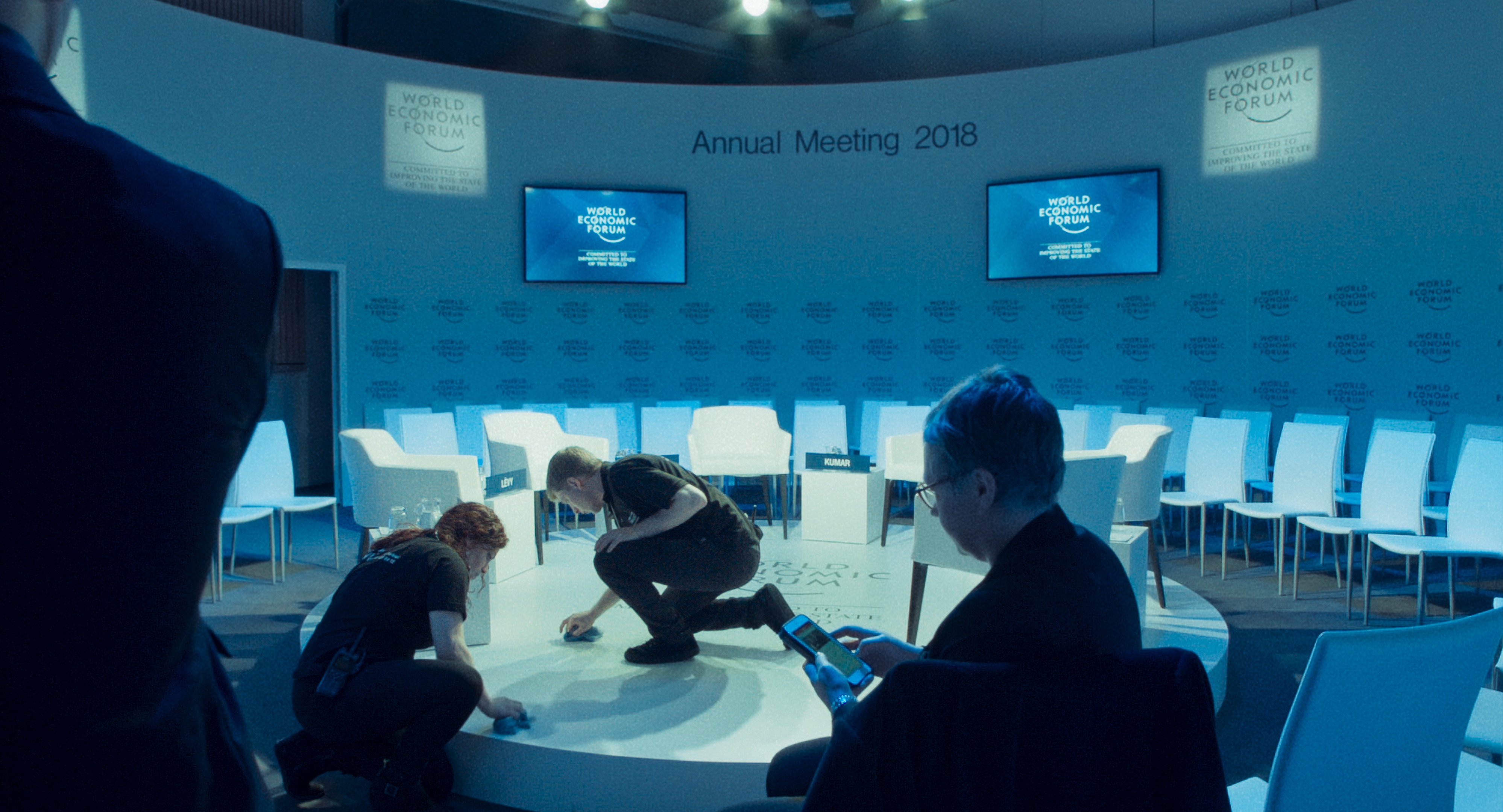
The collective’s most recent film to date is then largely an orthodox documentary: Davos. Every year, the municipality in the Swiss canton of Graubünden hosts the World Economic Forum (WEF), a glamorous gathering of influential figures in the global economy that is exclusive by virtue of its geographical setting alone.
In 2019, Donald Trump, Angela Merkel, Greta Thunberg and numerous central bankers were among those who came to Davos. Together with Julia Niemann (screenplay and co-director), a key collaborator in the European Film Conspiracy, Daniel Hoesl filmed on location for a year and a half, allowing the Swiss mountain village, which is also a small town, to become a model of the world in its own right.
For here one encounters much that reflects the state of the world today: young men from Afghanistan in a transit centre, a permanent guest in the presidential suite of a luxury hotel, a fishing club formed by Portuguese migrant workers, a museum guide who explains a view of the town from the early 20th century in such a way that the image can be seen as a (defensive) reaction to Thomas Mann’s novel Der Zauberberg.
After a good hour, the actual event begins, but Hoesl and Niemann are not really building towards it; instead, they embed it within a larger picture of nature and the economy: at the Forum, Davos adopts a second-order observational perspective, particularly strikingly, for example, during an interview conducted by a Swiss journalist with Klaus Schwab, founder and executive chairman of the WEF, in which Hoesl also records several moments when Schwab refuses to answer – moments that would of course be cut from a television broadcast.
Significantly, Greta Thunberg and Donald Trump are never seen, while Angela Merkel is heard only once from behind a door guarded by a hostess. Instead, the Ambühl mountain farming family illustrates what economic activity originally meant and just how far the representatives of the global economy gathered at the WEF have moved away from it. There, they simply no longer know what a cultural asset is, perhaps not even what is good and right at all.
*Lives as an author and journalist in Berlin.


