



Epicentro
Oscar®-nominated director Hubert Sauper's latest documentary is a haunting portrait of "utopian" Cuba and its unyielding people, a century after the USS Maine exploded in Havana - an event that ushered in another form of modern world conquest alongside the hegemony of American imperialism: cinema itself.
"As a filmmaker, I translate the world as I see it - and as it moves me - into 'images that move.' I try to challenge mainstream thinking." HUBERT SAUPER
Oona Chaplin, Fena LeChuck, Juan Padrón, Hubert Sauper and more
DVD Edition # 358

ABOUT THE FILM


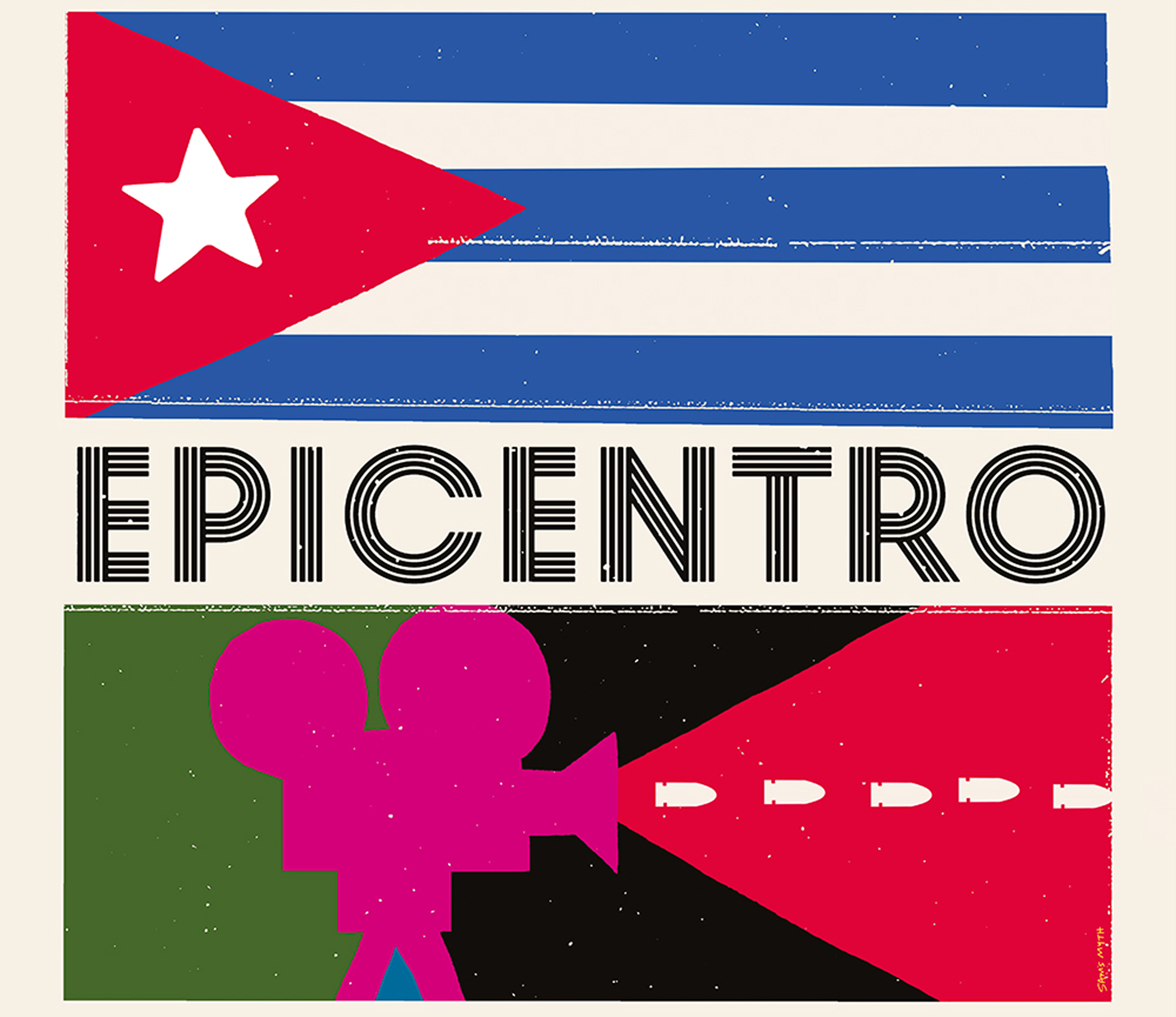


A Poetic Change of Sides
The Cuba of Hubert Sauper’s “Epicentro”
Bert Rebhandl*
Hubert Sauper is the anti-tourist. He did not come to Cuba for the palm trees, the rum, or the shuffling dances. He chose this island, lying so immediately beside the imperialist USA, because he is searching for a vantage point from which the world can be unhinged. Or at least freed from the frameworks once created by photo albums and now found on Instagram: a utilitarian commodity form for trophies from the exotic.
In his lyrical-essayistic documentary Epicentro, Sauper at one point stands opposite a classic tourist, a traveler armed with an expensive camera. The contradiction is so fundamental that it clarifies the experiment Sauper pursues in and through Epicentro: changing sides, in every possible sense. No longer hegemonic, no longer Northern, no longer intellectual, no longer modern, no longer cosmopolitan, no longer a reporter.
In truth, this is impossible — at least not for a man who cannot simply throw away his Austrian social insurance number. But if this change of sides, this individual anticipation of a world revolution, could take form, then perhaps it would look like the one Sauper attempts in Epicentro. A life alongside ordinary people in the last arguably communist state left over from the twentieth century. Sauper is a romantic of tropical nights, extracting marvelous effects from the combination of cheap cameras and unearthly beautiful light.
“Sauper is a romantic of tropical nights, extracting marvelous effects from the combination of cheap cameras and unearthly beautiful light.”
Epicentro is also a film of discourse, as befits the political left, yet Sauper’s reflections on the state of the world are never dogmatic; rather, they take on a searching, poetic form, seeking not proof but fleeting flashes of beauty. It is a little as if someone were fighting globalization with epiphanies — globalization, which sees only commodities everywhere Sauper finds truths.
Prophetic truths, to be more precise. His two most important figures, two girls on the threshold of puberty, are identified in the credits as “little prophets.” This too is a familiar trope: siding with children against overpowering systems of rationality (the same systems that spread unfair free-trade regimes across the world).
Sauper turns himself into a child, an accomplice, a conspiratorial friend who lets himself be drawn into an innocence whose loss Leonelis and Amielys already foreshadow as they try on women’s dresses. These are eroticized images through which Sauper attempts to capture his Cuba — one in which Charlie Chaplin’s granddaughter eventually sings a song and in which the waves of the Caribbean Sea become a visual poem.
*Lives in Berlin as an author and journalist (FAZ, Der Standard).
As a filmmaker, I translate the world as I see it—and as it moves me—into ‘moving images.’ I try to challenge mainstream thinking.
HUBERT SAUPER
The Struggle for Paradise
Hubert Sauper in conversation with Karin Schiefer about Cuba, clichés, and children.
ABOUT THE PERSON: Hubert Sauper is an Austrian documentary filmmaker. Darwin’s Nightmare was nominated for an Oscar in 2006.
Schiefer: This kind of film requires an enormous amount of time. How much time did you spend there in order to form a picture?
Sauper: It is characteristic of all my films that each time I impose a challenge upon myself and confront subjects that are actually too large for me alone and for a feature-length film. Explaining so much within two hours is essentially impossible. It is part of my approach not to have specialists explain complex interconnections. Interestingly, I always return to children, usually at an age when a kind of political awakening is beginning, while childhood is still palpable. For me, they are “truth speakers” or “young prophets,” as I somewhat ironically called them in Epicentro.
Schiefer: The protagonists are selected very precisely, yet one gets the impression that you are always open to whatever comes your way.
Sauper: One of the challenges lies in the fact that my films are highly conceptual but look as if I simply happen to meet people on the street and happen to speak with them about geopolitics or the moon. But that is not the case. If someone expresses geopolitical opinions in front of my camera, many nights have preceded it during which I wandered through Havana with them and discussed Guantánamo, interventionism, and the conceptual framework that is the film’s subject. At some point they then say, not entirely seriously of course: “We have to make the moon great again.”
Schiefer: American imperialism, spread through Hollywood soft power, is one aspect of the film; a new imperialism, that of global tourism, becomes an increasingly important theme as the film progresses.
Sauper: In Havana it is extremely difficult to film an image that does not instantly become a cliché. What is interesting about clichés is not the fact that they exist, but the question of where they come from. Once you analyze that, things become interesting again, and it allows you to photograph clichés within a new context. I was especially fascinated by the parallel between military and tourist intervention. For me, GIs entering Baghdad heavily armed create a parallel to American photographers wandering through Havana with three telephoto lenses hanging around their necks.
Schiefer: You leave the audience with ideas of paradise. What associations with paradise remain for you personally at the end of the film?
Sauper: Utopia, dystopia, paradise, nirvana — these are all conceptual or religious ideas that are part of our civilization and our narratives. The moment one examines them more closely, they become — intellectually speaking — increasingly fantastical and, strictly speaking, increasingly ridiculous. The so-called paradise in the religious sense, as a garden full of fruit, those confused depictions of an allegedly ideal place, are so deeply embedded within us that we constantly try to reproduce them. While making Epicentro, it dawned on me that paradise does not exist as a physical place and never can. But perhaps it exists as a fragment of time.


