



Hotel
Irène starts her job as a receptionist at a renowned mountain hotel. She soon discovers that her predecessor has mysteriously disappeared. Irène's own fate begins to intertwine with that of her predecessor - the hotel and its staff playing an uncanny role. Soon Irène finds herself threatened by a mysterious danger that she desperately tries to escape. "A life in the gating. HOTEL continually produces a void that the film deliberately does not fill. What we see is not everything, but enough." ISABELLA RICHER
"In the end, death awaits us. We just don't know when, how or why it will happen." JESSICA HAUSNER
Franziska Weisz, Birgit Minichmayr, Marlene Streeruwitz, Rosa Waissnix, Peter Strauß, Christopher Schärf and many more
DVD Edition # 15

ABOUT THE FILM


Habitual Chills
A Strategy of Refusal: Jessica Hausner’s Hotel
Annett Busch*
The title of Jessica Hausner’s film is Hotel. A place full of potential, and notably not a name, not a person. Lovely Rita was the title of Hausner’s first feature film. Rita, who had grown tired of being “lovely.” One could almost generate an entire genre from the accumulation of first names in film titles. Humour and self-confidence, melodrama and labour struggles—whatever the heroine may experience, the title serves as a reminder of who stands at the centre of the story.
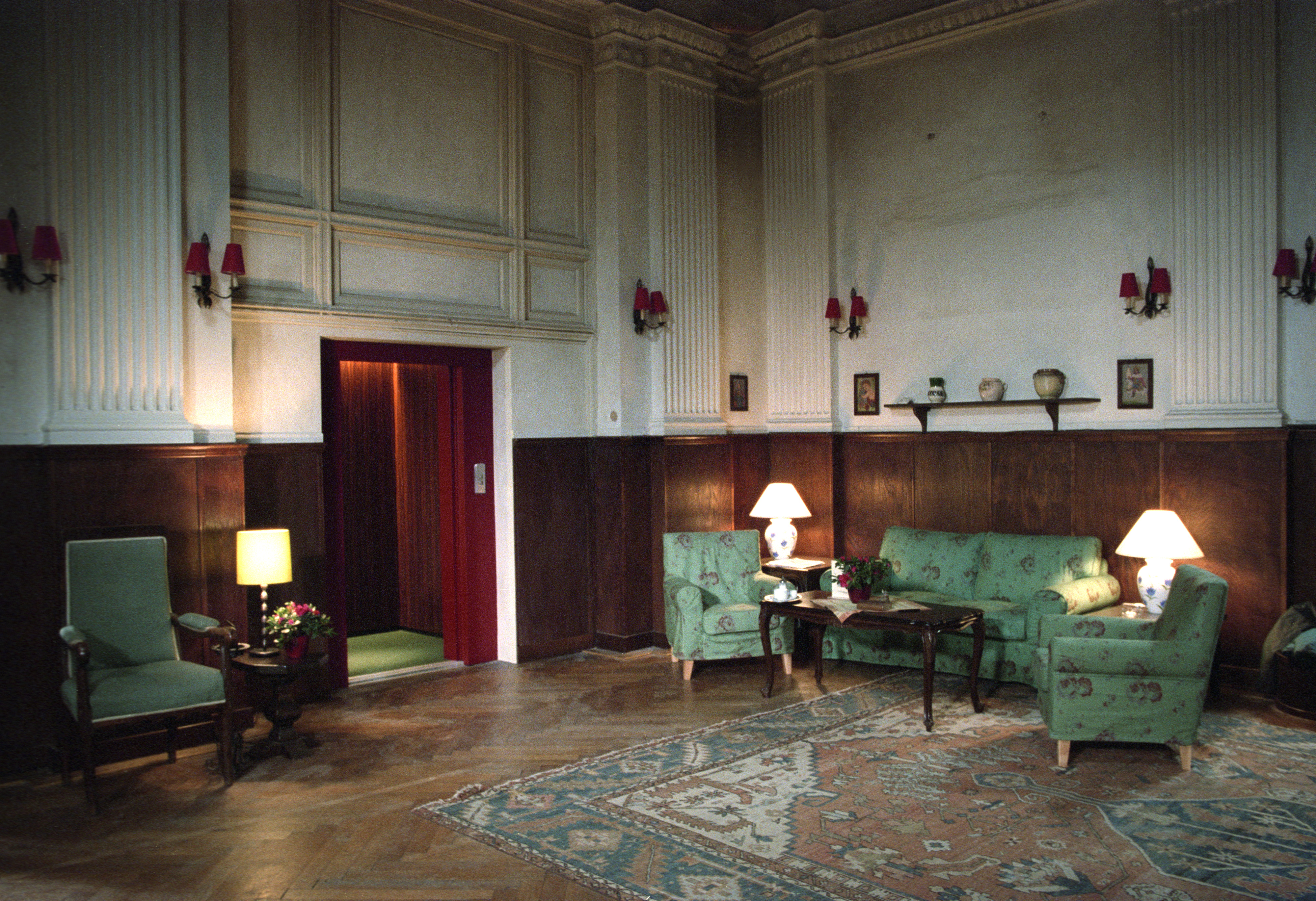
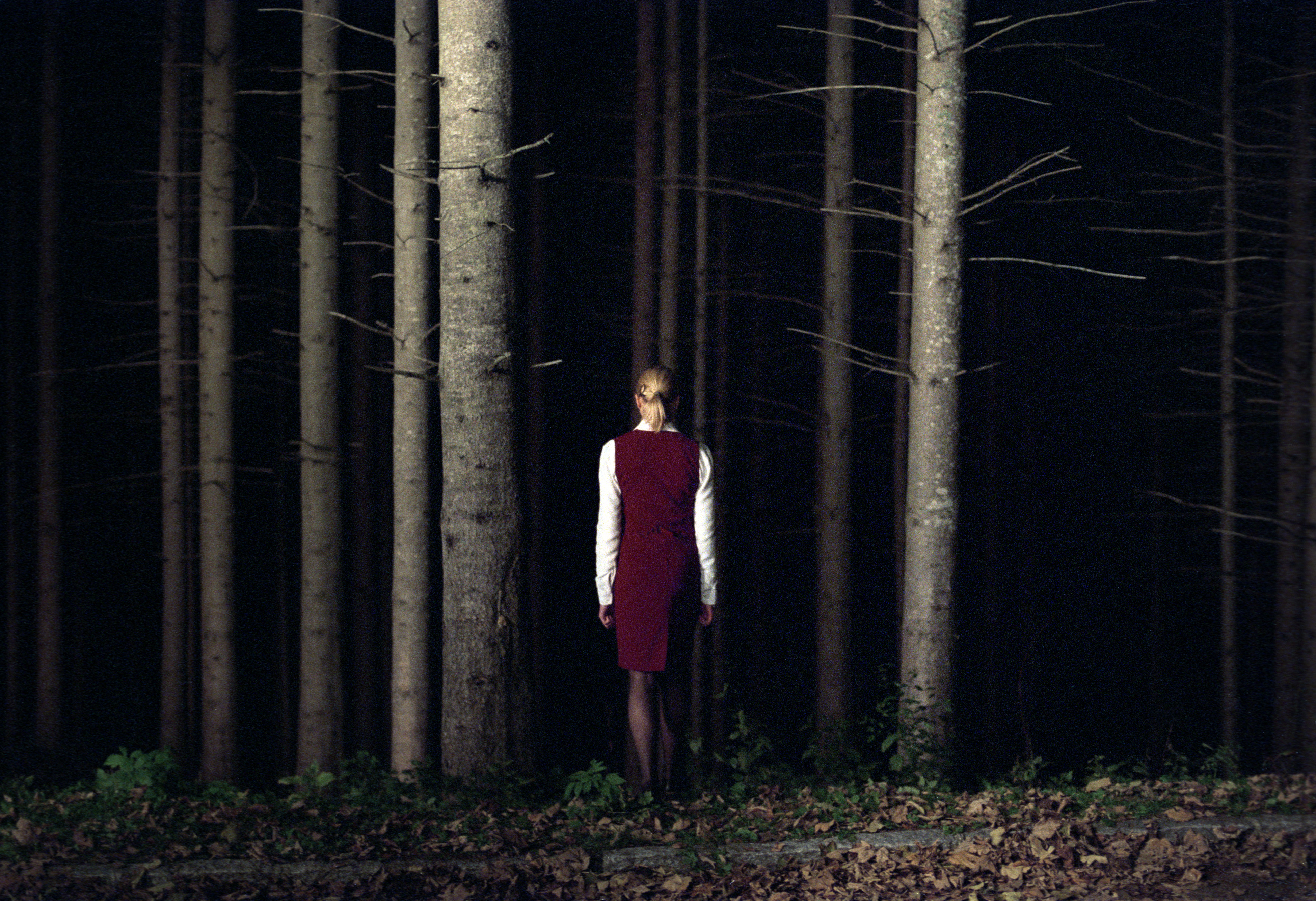
A hotel, however, does not initially have a centre; it has a reception desk. A small, internationally oriented control point that generally requires communication skills and a talent for multitasking. But in Austria, things sometimes work differently. Irene (Franziska Weisz), the protagonist of Hotel, has taken a job as a receptionist at the “Waldhaus.” It is no grand hotel, and guests appear only sporadically. The forest surrounding the building is not staged as an idyllic recreational landscape but as something abstractly uncanny. At times, the cluster of trees even resembles wallpaper.
Jessica Hausner borrows suspense as a stylistic device but deliberately allows our expectations to come to nothing. The significance suggested by the camera—through its unusual attention to seemingly useless spaces—remains without consequence. The uncanny stays bound to Irene’s subjective perspective, and the ghost story unfolds less in the dark forest than in the expressions and behaviour of her colleagues, in repetition, in habit.
“Jessica Hausner borrows suspense as a stylistic device but deliberately allows our expectations to come to nothing.”
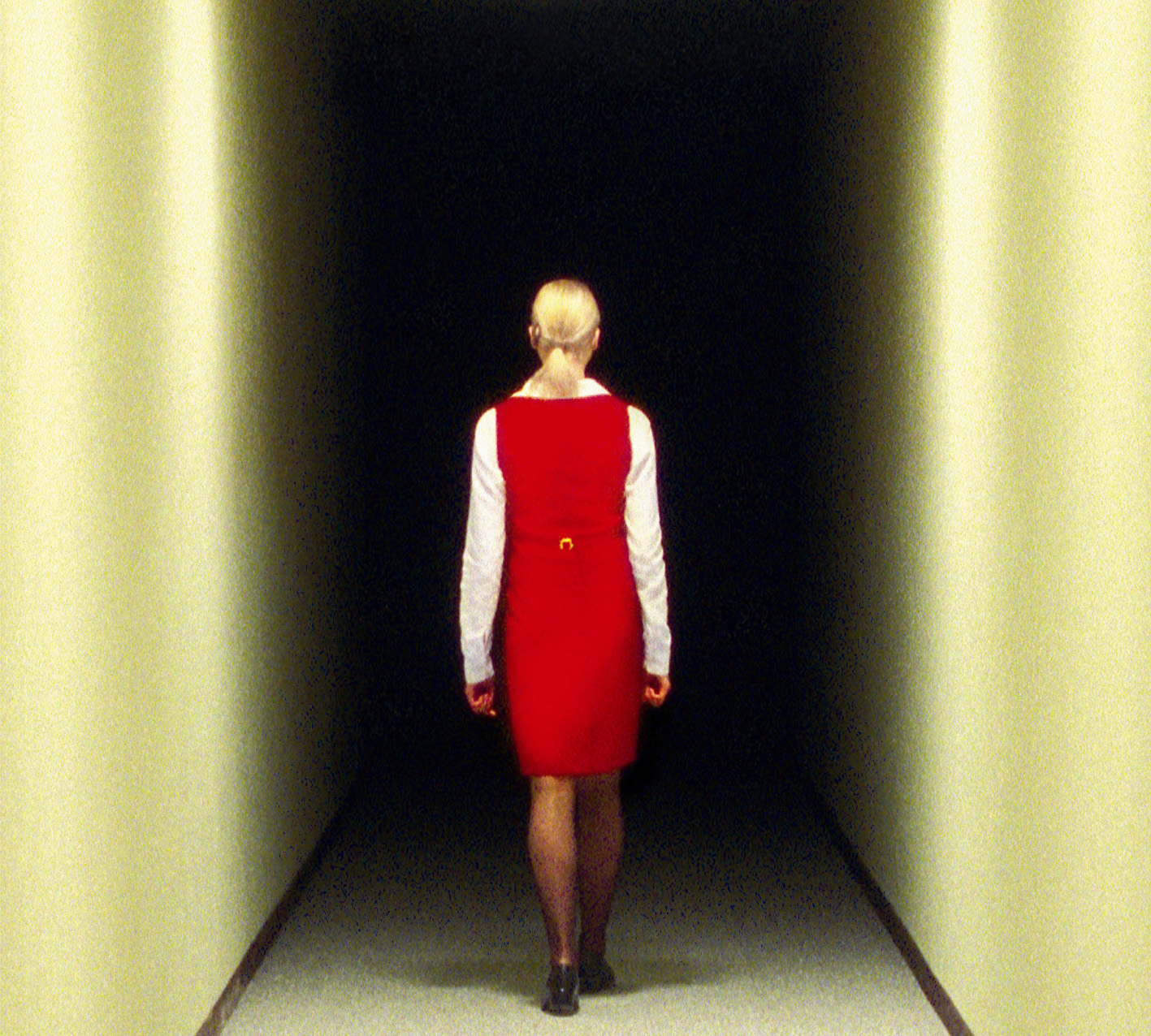
Irene simply wants to do everything right. Neat and proper, her thin blonde hair pulled tightly back into a ponytail, always with a friendly word on her lips, she wants to inject some energy into the place. Yet every ambition is crushed before it can take root. “Too much thinking is never good.” Clear compositions—and a few bars of music—structure this film. We often see Irene in medium-long shots as she enters the frame and then disappears from it again, while the camera continues to stare at the now-empty space. Much happens off-screen. Hausner refuses to bring anything to a conclusion. By the end, one might wonder why the film is not simply called “Irene.”
This dry attitude of refusal does not merely evoke thoughts of a new Austrian school of filmmaking. It is even more reminiscent of young contemporaries from Berlin—films such as Milchwald (Christoph Hochhäusler), Marseille (Angela Schanelec), and Bungalow (Ulrich Köhler), which likewise shift focus and expectations before the first image even appears. Marseille is not a city guide, and Bungalow is not an instruction manual for construction, but their titles point to the fact that social events are being narrated indirectly through buildings or urban architecture. The opposite of melodrama.
*Freelance writer, film critic, co-founder of www.missingimage.com.
In the end, death awaits us. We just don’t know when, how, or why it will happen.
JESSICA HAUSNER
The Wanderer of Loneliness
Jessica Hausner: A Profile*
Stephan Hilpold
Jessica Hausner: Two weeks ago, her new feature film screened at the Diagonale and promptly won both the festival’s Grand Prize and the Thomas Pluch Screenplay Award. Hotel has just opened in Austrian cinemas. It is the story of a young receptionist who finds herself in a dimly lit hotel. Situated deep in the forest, it is surrounded by trees standing so upright that each seems individually driven into the ground. A dark, mysterious film, marked by a profound sense of paralysis and loss. (...)
Loneliness, emotional emptiness, the inability to communicate: these are Hausner’s classic themes, beginning with her first short film Flora, which she made in 1996 while still a student at the Vienna Film Academy, continuing through Inter-View, a 45-minute film about a man who asks passers-by on the street to define happiness, and extending to Hotel. These themes also form the conceptual bridge connecting her work to that of a broader group of contemporaries.
Film circles spoke of an “Austrian Nouvelle Vague” when the group surrounding Hausner (born in Vienna in 1972), Barbara Albert, and Ruth Mader emerged a few years ago with a whole series of films. “The next generation takes the helm,” newspapers proclaimed. Suddenly, domestically produced films were once again appearing in Austrian cinemas—films people talked about and felt compelled to see. Alongside Albert’s Nordrand, it was also Lovely Rita, Hausner’s teenage tragedy, that revealed a distinctive cinematic voice. Shot with amateur actors and on video, the film centres on a young girl (Barbara Osika) who cannot cope either with herself or with her surroundings. (...)
“Yes, there is certainly something that unites us—how we tell stories and which stories we choose to tell,” Hausner says about her generational peers in Austrian cinema, adding: “Of course there is such a thing as Austrian film.”
Together with Albert, Antonin Svoboda, and cinematographer Martin Gschlacht—who worked behind the camera on both Lovely Rita and Hotel—Hausner founded the production company coop99 several years ago. Specialising in arthouse films, the collective achieved major success as co-producer of Hans Weingartner’s Die fetten Jahre sind vorbei.
If one wished to describe their shared artistic orientation, one might speak of stories drawn from (Viennese) life, of an authentic visual language, and of “real” characters. “It’s difficult to speak of social realism; Hotel, for example, doesn’t fit that pattern at all,” says Hausner, preferring instead to talk about coop99 as her working family: “We advise each other, we help each other, we support each other.”
*For RONDO (April 1, 2005), the director posed for a photo shoot (excerpt from the text).


