


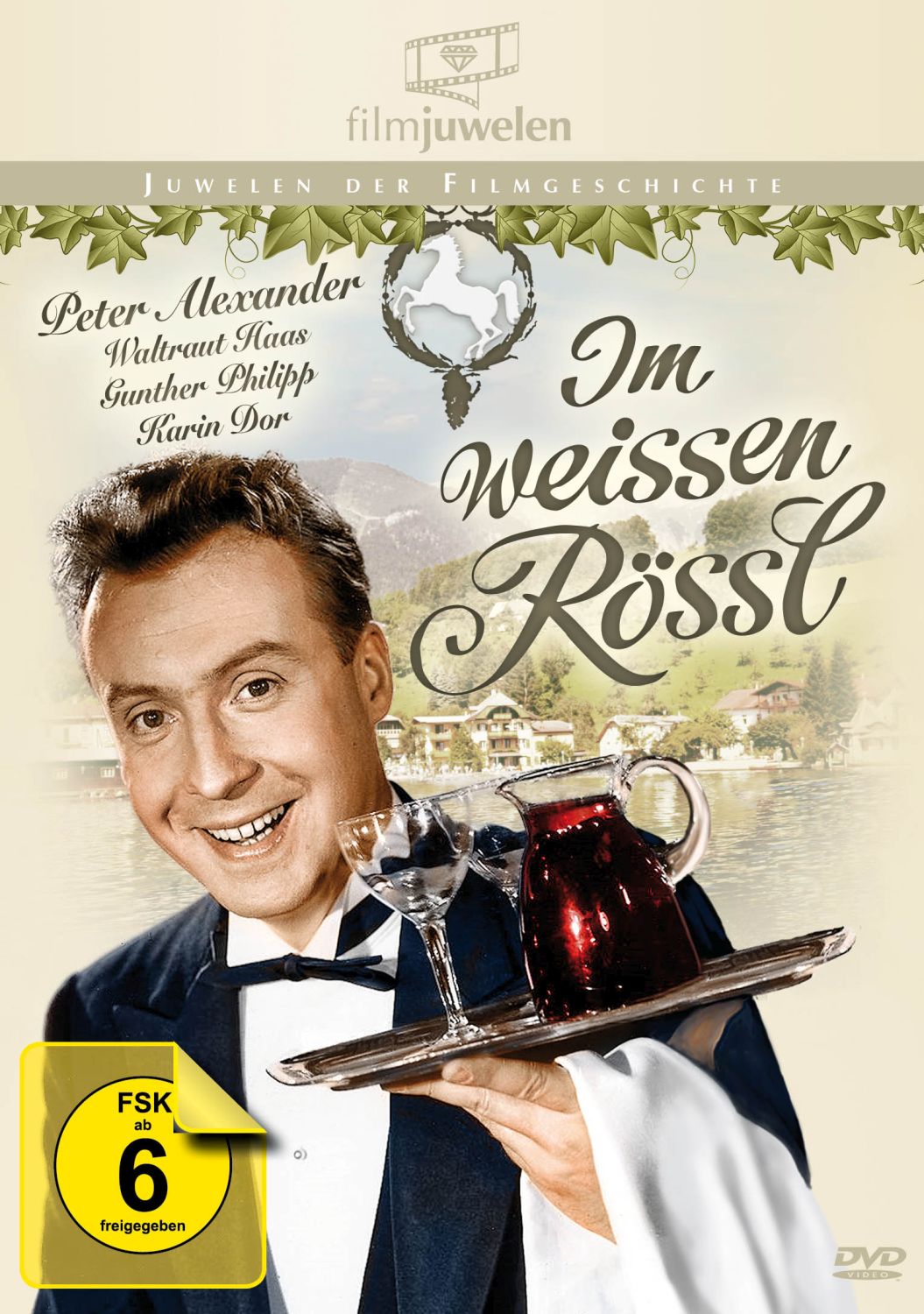
Im weissen Rössl
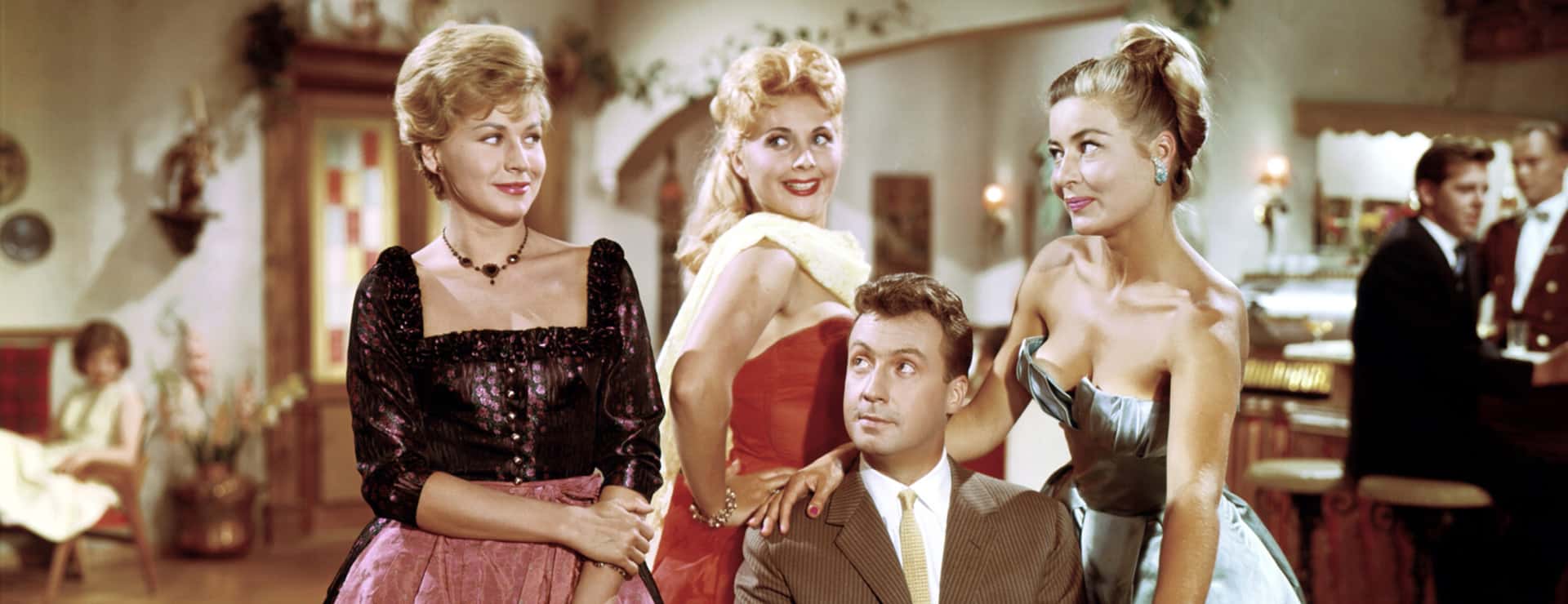
Leopold is the head waiter at the “Weisses Rössl” on the idyllic Wolfgangsee and is secretly in love with the pretty landlady, Josepha. However, since she has her eye on the lawyer Dr. Siedler, Leopold hatches a daring plan: He assigns the apartment reserved for Siedler to the charming factory owner’s daughter, Brigitte, who promptly catches Siedler’s attention. Unfortunately, Leopold’s antics are exposed, and Josepha fires him. But now nothing at the hotel is running smoothly—so Leopold comes up with a clever plan to save both his job and his love for his boss…
Waltraud Haas, Peter Alexander, Adrian Hoven and many more
DVD - Im weissen Rössl
ABOUT THE FILM



Bonus Track: Michael Niavarani über "Im weissen Rössl"
Kurator Florian Widegger über "Im weissen Rössl"


The Adorable Boss
On Werner Jacobs’ cult comedy Im weissen Rössl, starring Peter Alexander as a lovesick buffoon
Bert Rebhandl*
In the Salzkammergut, there’s plenty of fun to be had!” The lyrics to a melody from a musical play by Ralph Benatzky set the tone for Werner Jacobs’ comedy Im weissen Rössl. The hotel of the same name on Lake Wolfgang once welcomed “the Emperor himself” as a guest. The original play is still set during the monarchy, as is a film adaptation made just a few years earlier by Willi Forst. But now, 15 years after the war, tourism had clearly become a thoroughly modern affair. The Emperor only makes an appearance as a play on names: a steamboat is named after him, bringing a group of guests who have just thirty minutes to eat at the Weisses Rössl: Hurry, hurry! Avanti, avanti!
Even when everything has to happen at breakneck speed, head waiter Leopold Brandmeyer manages it all effortlessly. After all, he always wears the white cloth that identifies his profession draped over his left forearm. Leopold takes the pressure off the landlady and makes no secret of the fact that he is ready for a bigger role: a place at the side of Josefa Vogelhuber, whom he adores as Seferl, Peperl and Cheferl. But she is not receptive to his advances, even though he is (or perhaps precisely because he is?) a “dear, nice fellow”. Peter Alexander plays Leopold as a lovesick buffoon, someone who ought to know that this is hardly the way to achieve a happy ending: slapstick, after all, is the art of slipping up one more time before getting there.
Director Werner Jacobs, who a year later would also make the definitive film about another Austrian tourist myth, Mariandl from the Wachau region, pulled out all the stops with his version of Im weissen Rössl: three engagements, countless complications and plenty of spectacular interludes. At one point, Leopold even has to take to water skis with a tray balanced on his left arm, and with the help of a parasol he takes to the skies! No wonder he is briefly “under the weather” afterwards, while Cheferl is still pinning her hopes on Dr Siedler from Berlin, a bronzed heartthrob who arrives in a sports car and immediately falls for the younger Brigitte Giesecke (Karin Dor).
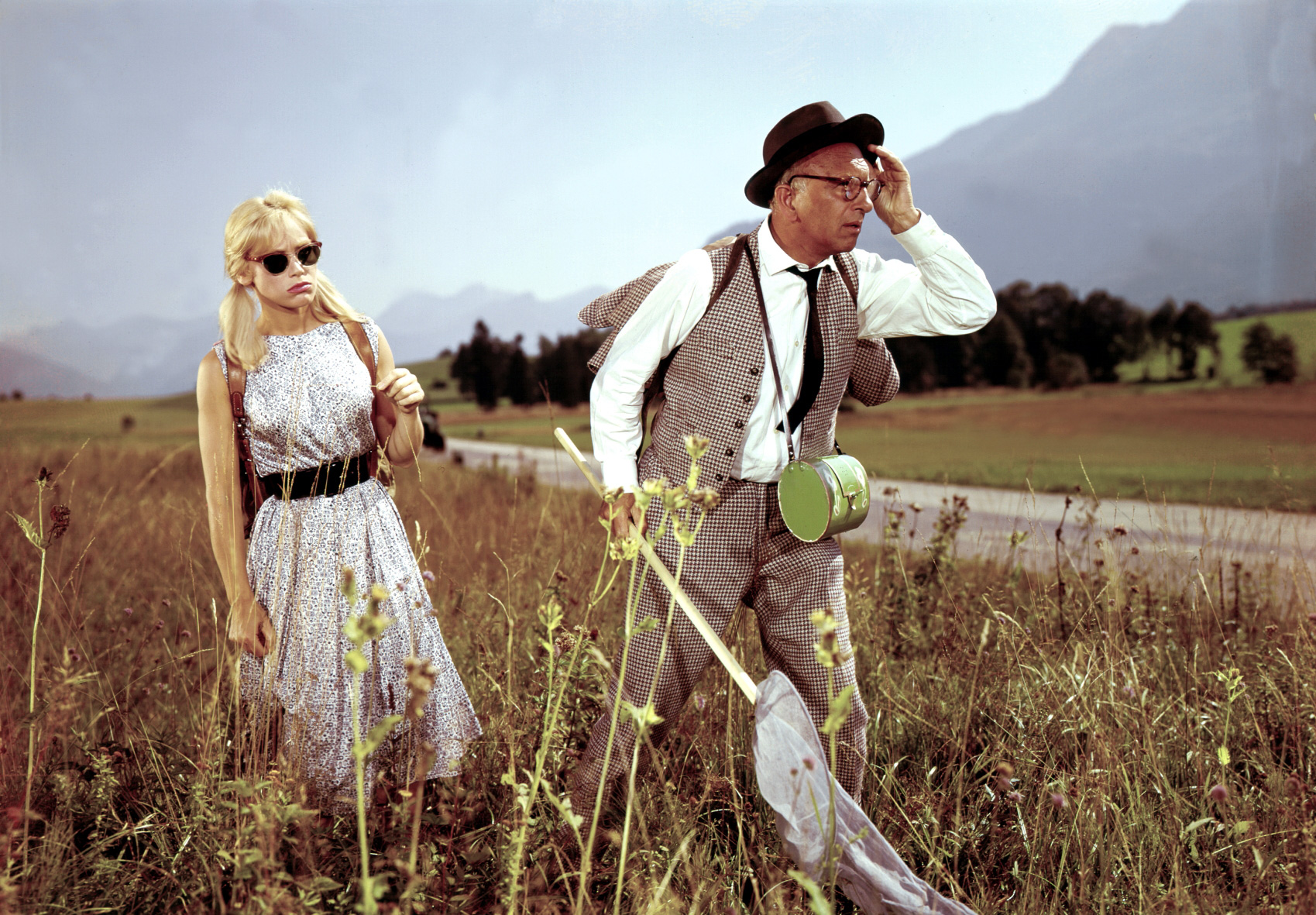
As the complications unfold, all the famous locations are visited: the steam railway takes everyone up to the Schafbergalm, while traditional Styrian dress is worn for a trip over to the Seeschlösschen. Men travel conspicuously often with their daughters, as though they wanted to present them as prospective brides while keeping them close at hand. Even an entomologist named Hinzelmann, who strongly opposes the “Moloch of Profit”, has brought his Klärchen along, and she ends up with the most spectacular action hero of all: Sigismund Sülzheimer (“How can Sigismund help it if he’s so handsome?!”), who lands in front of the hotel in a helicopter and even anticipates the drone delivery of luggage! But Sigismund has one weakness – he wears a toupee, which the wind blows into a tuba during a fire brigade festival.
It must be wonderful to be loved by you.
PETER ALEXANDER AS HEAD WAITER LEOPOLD
Originally, Im weissen Rössl was a work of light entertainment, a cheerful piece of musical theatre. Werner Jacobs, however, does everything he can to jazz up what he found in the musical play or operetta, so much so that the film could just as easily have been called Moderne Zeiten am Wolfgangsee. But that would not have sold nearly as well. Peter Alexander, with his irresistible voice, takes his role quite far into the territory of bumbling comedy. It is hardly surprising that the landlady does not consider him a suitable man for her. Yet although the film features plenty of other men, they are even less suitable – and part of the formula of comedies like Im weissen Rössl is that the unmarried woman must ultimately be rescued from her fate.
Waltraut Haas, as the landlady, has a brief, almost tragic moment when she tells Leopold, “That’s just the way life is,” as she announces their professional and personal separation – even though they are not actually together at this point and are by no means as clearly destined for one another as one might assume. Waltraut Haas’ Josefa remains something of a blind spot amid the commotion Werner Jacobs orchestrates. Even Franzl, the young waiter, eventually loses his patience: “No matter how you treat these women, it’s always wrong.”
Comedies simply work on the principle that you have to get a great many things wrong before finally getting them right. Leopold even imagines himself as a bedside rug, a role he could also envisage playing in Josefa’s life. But his submissiveness exists only in fleeting fantasies; in real life, he holds together the “chaotic bunch” that emerges whenever he is not acting as head waiter. Even in the happy finale, private and professional life remain closely intertwined: “We are the boss” is also the formula for a wedding that is already entirely shaped by an industry central to the nation’s identity. The “magic of the season”, after all, lies in the fact that “a summer like this brings in money by the cartload”.
* is a film critic and author based in Berlin.


