


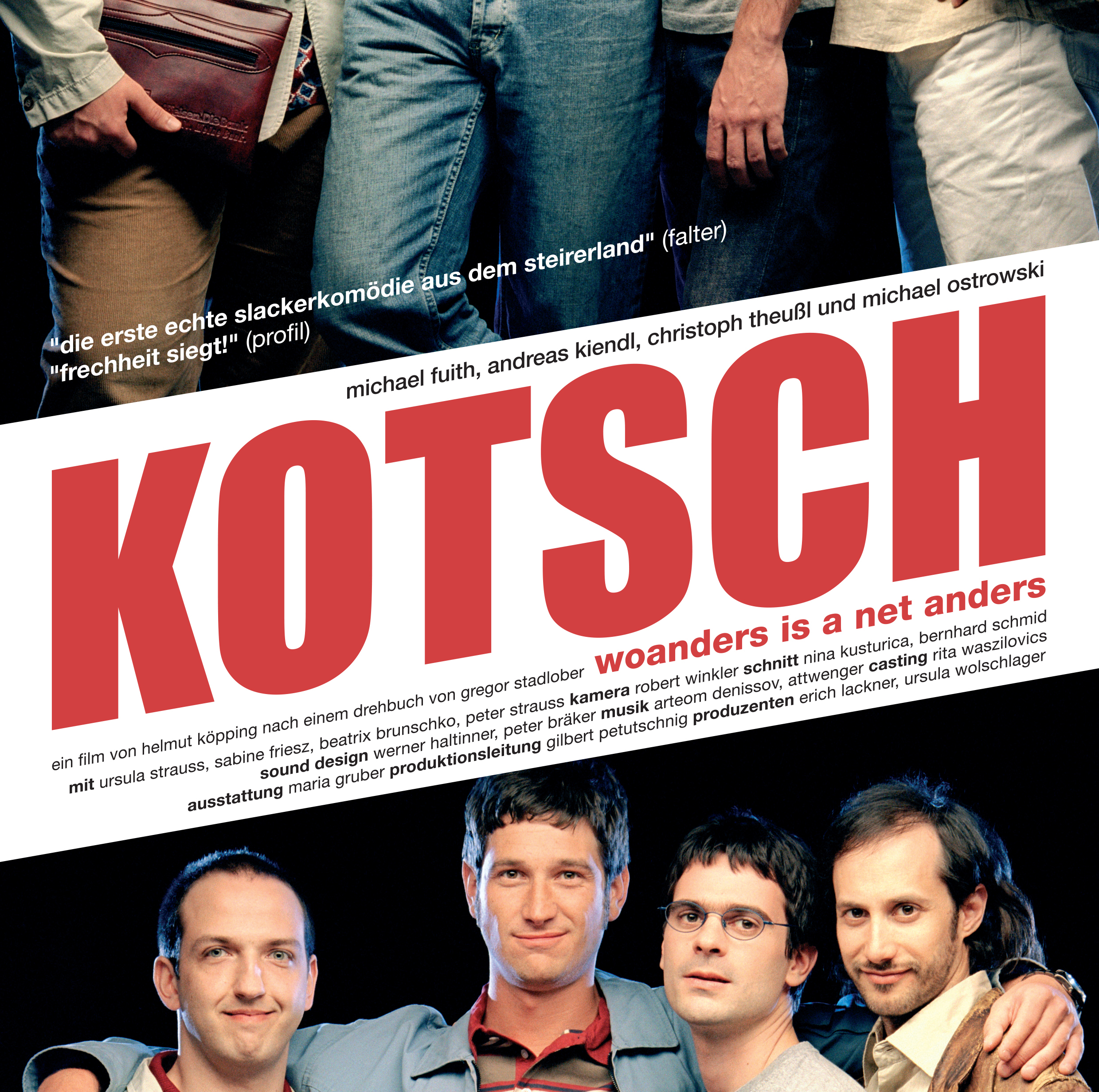
Kotsch
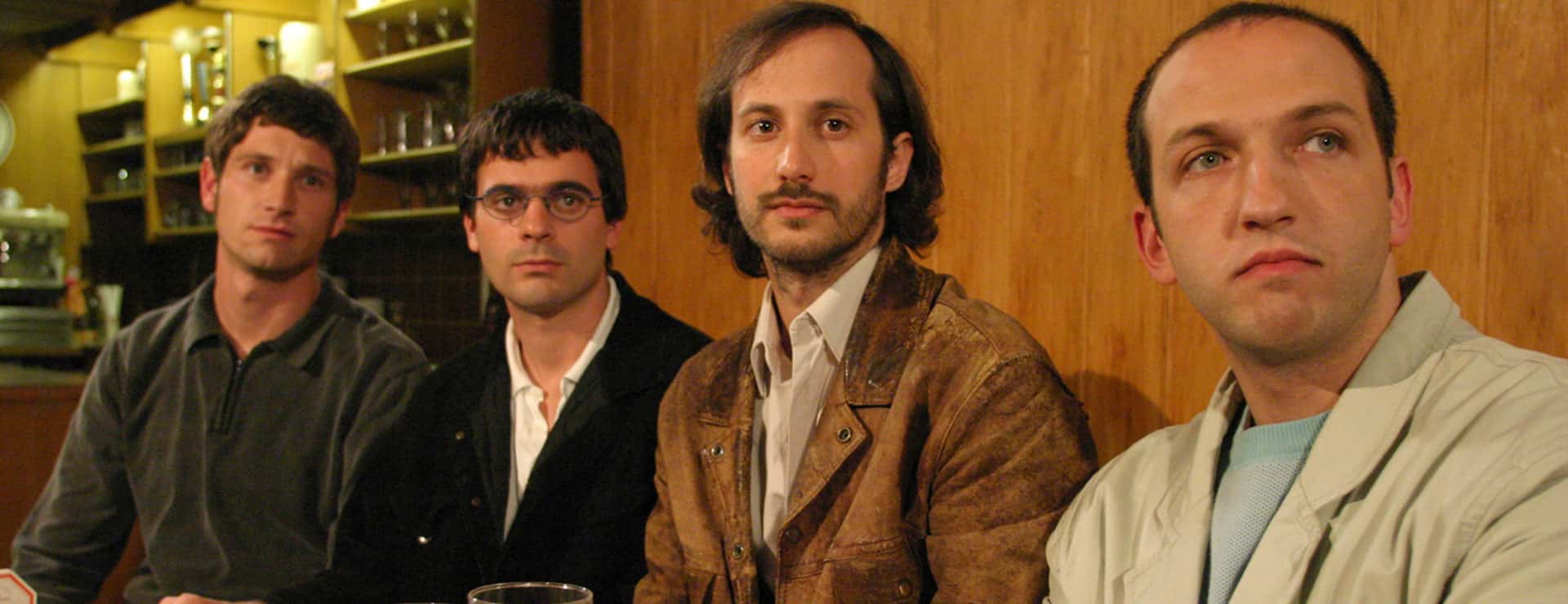
"KOTSCH, written by Gregor Stadlober, directed by Helmut Köpping, accompanies four anti-heroes as they stumble brilliantly through everyday life and small escapes into dream worlds, fairy included. The time: 1999 - Austria in pre-election fever. The setting: Fohnsdorf in Styria, Austria's largest village, a somewhat gloomy environment for undauntedly optimistic advertising posters for the then SP chancellor Viktor Klima. The protagonists: a group of young men and women, more or less lost in this village from which many have emigrated. The general condition: stumbling along in jobs that are not necessarily meaningful, as singles or in rather less fulfilling relationships. As a tragicomedy, KOTSCH develops considerable distance from domestic cabaret patterns." CLAUS PHILIPP
Christoph Theußl, Michael Ostrowski, Andreas Kiendl, Michael Fuith, Ursula Strauss, Sabine Friesz, Beatrix Brunschko, Peter Strauss, Susi Stach and more
DVD Edition # 48

ABOUT THE FILM




Everywhere Is Fohnsdorf, Isn’t It?
Notes on Particular Forms of Being Knocked Out
Claus Philipp*
Nothing happens. Only faster and faster. That, more or less, is how one might describe the prevailing mood that this film captures so paradigmatically for Austria in the run-up to the 1999 elections. The setting: Fohnsdorf in Styria, Austria’s largest village, which, following the closure of its lignite mines, has become a bleak backdrop for the relentlessly optimistic campaign posters of the then Social Democratic Chancellor Viktor Klima. The protagonists: a small group of young men and women, more or less stranded in a place from which many others have already left. The general condition: drifting through jobs that offer little sense of purpose (a drugstore, a tobacconist’s shop, an assembly line), living either alone or in relationships that are hardly more fulfilling, while constantly repeating drinking maxims such as “It’s no different anywhere else.” Kotsch: the title of the film, written by Fohnsdorf native Gregor Stadlober with great affection for local colour, can be read as a kind of more or less painful knockout (“ouch!”).
Inspired by American grunge comedies such as Richard Linklater’s Slacker, and perhaps also by the loser humour associated with Germany’s Detlev Buck, Kotsch develops, as a tragicomedy, a considerable distance from the familiar traditions of Austrian cabaret. More than that: although the cinematic means of theatre director and first-time filmmaker Helmut Köpping may still be somewhat limited, he nevertheless presents a small film in which one can already discern the outlines of a much larger narrative exploration of the Austrian state of mind.
“It seems as though nothing is happening. Only faster and faster. That more or less captures the prevailing mood this film conveys.”
This is due, first of all, to the screenplay, which does not reduce its characters (superbly portrayed by Christoph Theußl, Andreas Kiendl, Michael Ostrowski, Michael Fuith, and the outstanding Ursula Strauss) to mere joke machines. It also stems from the choice of a small-town milieu and working environments that Austrian feature films have generally preferred to ignore. And when they have been depicted, it has usually been under the banner of decay and desolation. As deeply as Kotsch explores despair, it remains at the same time a work that believes in the possibility of vital change. As simple as that may sound, it should not be underestimated—least of all in Austrian cinema, where folk heroes often prefer to settle comfortably into their resentments.
Thus, when an elderly bar owner begins dancing to Attwenger’s Woam at the end of the film, there is—despite the film’s overall open ending—a newly discovered joy in taking the initiative. And when the film quotes Austropop absurdities such as Klaus Prünster’s Wunderwelt, it does so without a trace of sentimental nostalgia; instead, it invites us to see the Ö3 charts and pop kitsch as symptoms of a broader social paralysis.
*Head of the Culture Desk and film critic at Der Standard.
“It’s no different anywhere else…”
“Cheers, Then...”
Helmut Köpping on Kotsch
ABOUT THE DIRECTOR: Helmut Köpping, director, was born in Graz in 1967. Since 1996, he has been the artistic director of Theater im Bahnhof, where he also occasionally performs as a stage actor. In 2001, this Graz-based institution received the Nestroy Award for LKH – eine Theaterserie. The screenplay for Köpping’s feature film debut Kotsch was written by Gregor Stadlober, who received the Carl Mayer Screenplay Award for it.
The year is 1999. The New Economy is booming, the US President is caught up in a sex scandal, the grand coalition carries on as usual—and the world still seems to be in order, also for Alf, Boris, Chris and Dalli. They are in their late twenties and share a long-standing, well-established friendship. They have known one another since childhood and fit together perfectly. Each has settled into his role and plays it consistently: Boris, the down-to-earth sensualist; Chris, the sarcastic intellectual; Dalli, somewhat slow and not particularly quick on the uptake; and Alf, the dreamy, shy one. The four of them “live and work” in Fohnsdorf.
When they were children, the place seemed enormous—the largest village in Austria, home to Europe’s deepest lignite mine. In the meantime, the mine has closed, Fohnsdorf has become a little smaller, while the boys have grown up, and the young Social Democratic mayor has brought a touch of “New Labour” to the town through new businesses and a shopping centre.
But within the boys’ own microcosm, signs of crisis begin to appear. Their jobs become precarious through little fault of their own, long-established rituals reveal their meaninglessness, and Alf gradually realises that the one who has been standing in his own way all this time is himself.
Not even the appearance of a fairy godmother can help—especially if, at the decisive moment, you make the wrong wish. Slowly, Alf begins to ask himself whether he has enough strength to take a step outside.
But that would require quite a bit of strength, because there is great comfort in remaining within the warm circle of friends. Besides, who knows what tomorrow will bring? And, as everyone knows, a good joke can go a long way.
So, cheers—here’s hoping our throats don’t rust.
Kotsch is told from Alf’s perspective. This subjective point of view allows our film to wander into daydreams, tiny observations, and heightened formulations. In this way, Kotsch has become a wild mixture of comedy and drama, commentary and comic strip, routine and surprise.
I like paths that lead into the absurd, the surreal, the cruel and the abyssal.
Kotsch is serious without being portentous, and funny without trying to be original.
I think that, in the end, things should turn out well.


