


Müller's Office
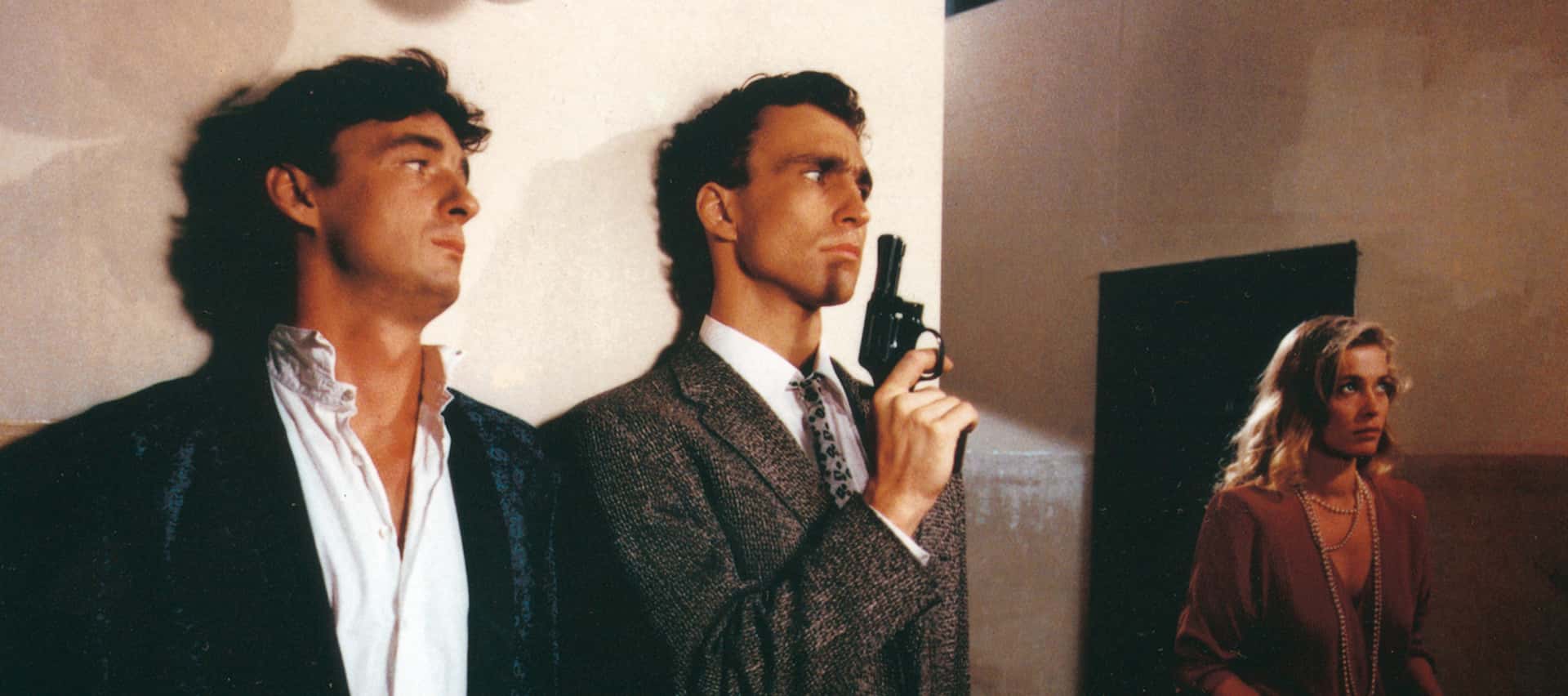
"A delightful, parodic farce. Director and writer Niki List plays tricks with the most famous detective characters in film history, with the themes of film noir, but also with ordinary soap operas. The smart male reincarnation of Sam Spade, Philip Marlowe & Co is simply called Max Müller. He also has an office and a pretty smart secretary, Miss Schick. As long as Müller doesn't get any orders and only empties the very last whiskey bottles, she sings "Because I'm so sexy" or "Men are like marzipan" with a trusting look in her eyes. Max Müller himself and his assistant Larry, borrowed from German TV series, are not made of marzipan, however. This turns out to be the case when the two of them receive a fat commission from a wealthy client named Ingrid Bergman (Barbara Rudnik has never been seen more mysterious). To reveal more would be mean." TAGESSPIEGEL
"When we made the film, laughter in itself was something like quality. It could also be seen as a service to the audience's health." NIKI LIST
Christian Schmidt, Andreas Vitásek, Barbara Rudnik, Sue Tauber, Maxi Sukopp, I Stangl, Jochen Brockmann, Gabi Hift and more
DVD Edition # 30

ABOUT THE FILM



The Calculated Naivety
Film Noir Meets Viennese Wit: Niki List’s Müllers Büro
Bert Rebhandl*
Men are like marzipan”: A motto that would seem entirely inappropriate for a film noir fits perfectly here. The detectives are not hard-boiled but easy-going. After office hours, the girl in the front office simply starts to sing. Müllers Büro—a satirical film noir musical born from the spirit of the New Wave that swept through pop culture in the 1980s. Catchy tunes suddenly became cool. They lighten a story that would otherwise be considered classic—were it not for its distinctly Viennese sense of the absurd.
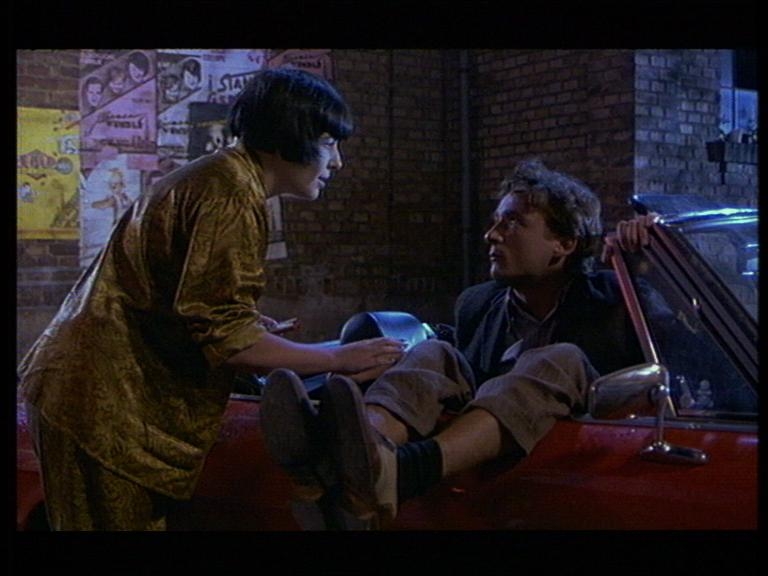
Private detective Max Müller (Christian Schmidt) is hired by a femme fatale (Barbara Rudnik) to find her boyfriend Mike. While Max and his friend Larry set to work, all sorts of things happen in Vienna’s underworld, which vaguely resembles Chicago in 1930. Some useful clues, however, are unmistakably contemporary: “Try the Blue Box.” The city’s crime bosses are called Meier, Montana and Delgado. Montana commands a gang of leather-clad girls, but Max Müller refuses to be intimidated by them. Meanwhile, the less manly Larry entertains himself with a girl, resulting in yet another hit song: “Ich will mehr.”
The plot of Müllers Büro is probably even more complicated than The Big Sleep, but film noir has always prided itself on the fact that not everything has to add up perfectly. In Niki List’s playful noir, everything resolves itself into gags.
“Surreal odes to the moon are sung in between, and there is always time for one penultimate drink beneath the neon lights.”
Müller carries mugshots in his underpants because that is the first place the easy girls look. The femme fatale is mysterious, but hardly buttoned-up. In between, surreal odes to the moon are sung, and there is always time for one penultimate drink beneath the neon lights.
Müllers Büro was an enormous success, largely because it delivered hits on several levels. The music helped the film, the film promoted the music, and the stylistic mix created numerous synergies. When conceiving Müllers Büro, Niki List stood with one foot in the history of American cinema. With the other, he stood in Vienna’s cabaret scene, which brought one of its leading figures, Andreas Vitásek, to the screen. Film noir met Viennese wit—a combination imaginable only in Austria, yet one that also won over audiences in Germany.
Harald Sicheritz wrote the song lyrics together with List—short lines of calculated naivety: “Weil ich so sexy bin.” Today, the 1980s are endlessly recycled in nostalgic television shows. Müllers Büro was already presenting a distorted reflection of its own era back then: coolness quickly becomes ridiculous, the crime film slips into the absurd, and Vienna is surrounded by its own clichés. Müllers Büro simply added a few more clichés borrowed from classic cinema. The result was a phenomenon well known from pop music: a “one-hit wonder.”
*Regular contributor to Der Standard, lives as a freelance journalist in Berlin.
When we made the film, laughter itself was already something like a quality. You could also see it as a service to the audience’s well-being.
NIKI LIST
Fully There: “The 1980s Revival”
Laughter as a Form of Quality: Müllers Büro
Niki List on Müllers Büro:
“When we made the film, laughter itself was already something like a quality. You could also see it as a service to the audience’s health. We already had a great time while making it, and when, after a run of 63 weeks, the film finally disappeared from the cinemas, that was perfectly fine too.”
“Clueless, with hardly any filmmaking experience whatsoever, many of my friends and I embarked on a project that had only one thing in common with my first film, Malaria: the people who were still crazy enough to believe that quality would ultimately prevail in filmmaking were back at work.”
“The spirit of the 1980s has certainly changed, but the revival is in full swing. Since the DVD was released, there has been a growing fan community asking for a sequel. Whenever I listen to the radio now, certain songs take me right back to the era of the Neue Deutsche Welle. So let’s have a sequel and enjoy, in the cinema, the time before AIDS and bird flu, when we didn’t have to retreat to the basement in order to laugh.”
From a report in the taz:
“Arriving late for a film is sometimes unavoidable at film festivals, but it is still a better sign than leaving early. By the time I wandered into this Austrian comedy, Müller and his buddy were already deeply entangled with the underworld—unless they happened to be in bed with a woman. The audience was clearly having a fantastic time; the roaring laughter could be heard all the way into the foyer. If there had been an audience award here, Müllers Büro would have been among the favourites. Because—and here the critic’s conscience reasserts itself—Niki List has embarked on a foray through film history in which no borrowing from either the best or the worst films of the 1950s seemed too far-fetched.
The private detective film, the ladies’ man, action films, musicals and rock films are all affectionately spoofed. The list could go on and on, as even the film-within-the-film device enjoys a new lease of life. If, as a director, you are not completely foolish, this simply has to work. Niki List is more than clever because he shamelessly plays the pleasure card. At one moment you feel transported into the musical films of the 1960s starring Peter Alexander; the next, The Rocky Horror Picture Show is being gleefully parodied, and there is even room for the classics—Fritz Lang sends his regards.
So anyone who wants to spend an hour and a half delighting in laughing at the expense of others will be thoroughly entertained. The cinema is certainly not reinvented here, but these often hilariously combined fragments of everything that has come before are, at any rate, far more entertaining than much of the strained filmmaking that supposedly points the way out of the current malaise. When nothing else works, Müller takes over. It is as funny as it is sad to watch.


