


Verschwinden/Izginjanje
In southern Carinthia, about 90 percent of all inhabitants spoke Slovene before 1910; today the percentage is in single digits. In her essayistic documentary, Andrina Mraˇcnikar formulates a highly political urgency in a personal way: What happens when one's mother tongue is taken away in everyday life? What must politics do to counteract the disappearance of a language whose protection is enshrined in the constitution? Awarded the Audience Award of the Diagonale 2022.
"A film as a plea against resignation and for spirited political action." DIAGONALE
Eugen Sitter, Robi Sitter, Christian Tusch, Alexander Koban u.v.m.
DVD Edition # 384

ABOUT THE FILM



Mother Tongue
“Verschwinden/Izginjanje” Advocates for Bilingualism
Bert Rebhandl*
Andrina Mračnikar grew up in Keutschach am See in Carinthia. In her language, Slovenian, the place is called Hodiše. German — or Austrian — is also her language, but Slovenian is the language of her family, and when she speaks tenderly with her little son Milo, she cannot do without her mother tongue.
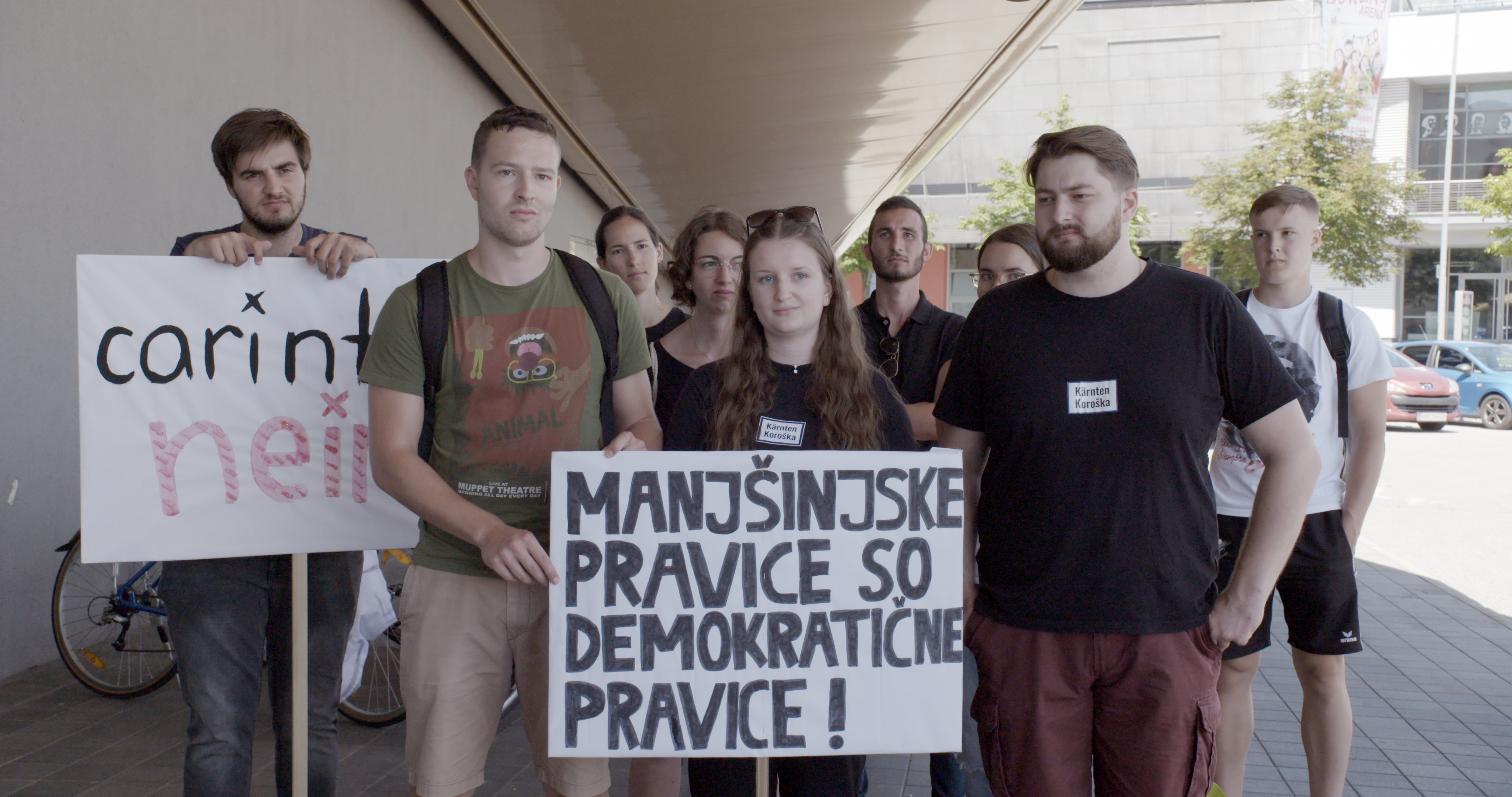
Yet fewer and fewer people in Carinthia are speaking Slovenian. “My generation never learned it anymore,” says a young man in the film Verschwinden/Izginjanje. With that, a culture also threatens to disappear — the identity of an ethnic group whose rights had already been guaranteed in the Austrian State Treaty but were never consistently respected.
This has to do with the particular history of Carinthia. In 1920, following a referendum, the federal state became part of Austria. While this created clarity on the one hand, it also initiated a hundred-year-long “ethnic group conflict” that continued to cause deep divisions even in the Second Republic. Andrina Mračnikar’s film can also be read as an assessment of these hundred years. She begins with her own family but also gives voice to important activists committed to ensuring that Slovenian in Carinthia does not simply disappear.
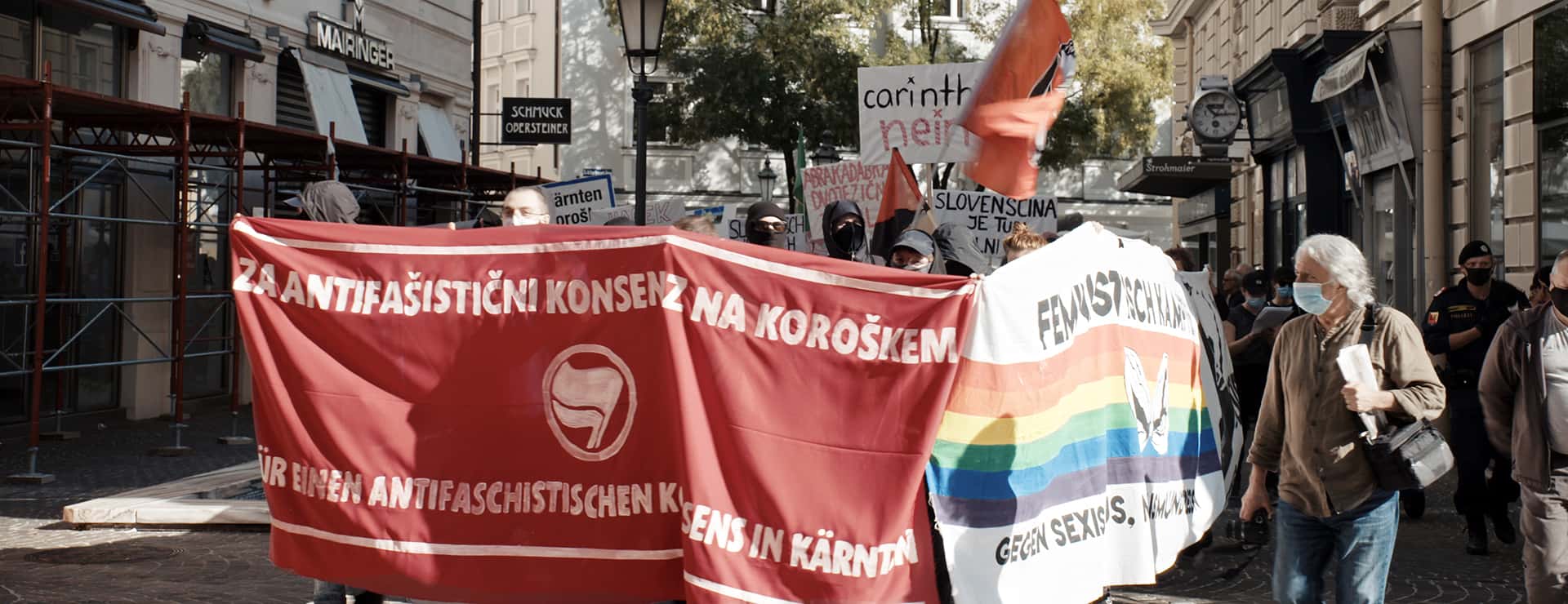
The bilingual town signs, which were bitterly contested for such a long time, are the clearest sign that both languages should remain present in everyday life.
“The film demonstrates how identity might be preserved without having to assert it through exclusion or even violence.”
In schools, instruction in Slovenian ends after the fourth year of primary school. Children hardly speak Slovenian while playing anymore; they experience the language only in exceptional situations as part of daily life.
Mračnikar once again recalls people who were persecuted and deported during the Nazi era because of their Slovenian identity — she herself made her first film about Andri Ogris, her grandmother’s brother. She is present when Carinthian governor Peter Kaiser lays a wreath at the grave of a former Nazi, and afterward even somewhat plausibly emphasizes “the processual nature” of his attempt to mediate between the still powerful right-wing nationalist forces in the region and the Carinthian Slovenes.
She is there when a celebration is held at her grandmother’s farm featuring a tamburizza group, and she shows a choir performing an old partisan song. She reconstructs a history in which, at the height of demagoguery, Slovenes insisting on their identity were mocked as “nationalists.”
“We are in a crisis nobody talks about,” someone says at one point. The film Verschwinden/Izginjanje demonstrates how identity might be preserved without having to assert it through exclusion or even violence.
*Is a freelance film critic. He writes for Der Standard, the FAZ, and many others.
A film that argues against resignation and in favour of courageous political action.
DIAGONALE
The Hanged Horse
On the Trauma of a Carinthian-Slovenian Family
Valerie Dirk
Alexander Van der Bellen was the first President of Austria who, in 2020 on the 100th anniversary of the Carinthian plebiscite, officially apologized to the Carinthian Slovenes — in both German and Slovenian.
The official apology was long overdue and moving, says one of the people in Andrina Mračnikar’s documentary Verschwinden/Izginjanje, yet the beautiful words changed nothing about the fact that much has already been lost.
As the older generations die, Slovenian in southern Carinthia is disappearing as well — it vanishes: “izgine.” The director approaches this through an intimate, essayistic perspective. In voice-over, Mračnikar, speaking gently and mostly in Slovenian, invites her own family as well as young activists into conversation, weaving together a deeply personal historical narrative about Carinthian Slovenes today.
The documentary situates events historically — above all the Carinthian plebiscite of 1920 and the bilingual-sign protests of 1972 serve as anchor points of the narrative — while also consciously omitting certain aspects. The name Haider is absent, and the conflicts following the bilingual-sign protests are only touched upon.
Although archival footage of the pogrom-like conditions around 1972 marks the beginning of the film, Mračnikar leaves the agitated 1970s behind — unlike the controversially discussed documentary Article 7 – Our Right!, which ORF refused to broadcast in 2006.
Mračnikar is concerned less with agitation than with emotion. For not only the bilingual-sign protests themselves, but also the petty bargaining over percentages that followed on the part of German-speaking Carinthians, were perceived as humiliations that became deeply inscribed into the consciousness of the Slovenian-speaking population.
In 1920, the Mračnikars voted for Carinthia to remain part of Austria, even though they were proud Slovenes. They had been promised equal treatment, including bilingualism, later also guaranteed in the 1955 State Treaty.
How deep the divide between German and Slovenian speakers truly was became evident in 1938, at the time of the Anschluss to Nazi Germany. “Carinthia speaks German” appeared every few meters. Later, hundreds of Carinthian-Slovenian families were deported to concentration camps and labor camps — a subject the director had already addressed in her earlier documentaries Andri 1924–1944 (2002) and The Carinthian Speaks German (2006). Mračnikar’s great-grandfather was imprisoned in Dachau concentration camp, and her great-great-uncle died at the age of twenty as a partisan in the resistance. After the war, Nazi ideology remained deeply rooted in people’s minds. For the Mračnikar family, the symbol of this hostility is a dead horse. During the bilingual-sign protests of 1972, unknown perpetrators hanged it in the stable. There were never any consequences for the killers of the horse.


